
In this guide
Codec recognition is only one layerChannels and timing need their defined mappingAvoid universal quality or support promisesOpus is an audio codec specified for a wide range of speech and music applications, including interactive use. It can operate across different coding conditions; a codec name alone does not specify the complete source configuration or output path.
The container and transport remain separate. Ogg encapsulation for Opus has its own specification, while other delivery contexts use their own framing and support requirements.
Codec recognition is only one layer
A player may need a container parser, correct Opus track/header handling, a decoder and an appropriate output configuration. Recognizing the word Opus does not establish every combination of container, channel mapping and streaming presentation.
An original hypothetical browser can play one Ogg Opus file while another application receives Opus in a different unsupported packaging context. The first success is not a test of the second parser path, even if both resources use the same codec family.
Channels and timing need their defined mapping
The Ogg Opus specification defines identification and channel mapping information. Some mappings have ordering conventions different from other audio formats, so conversions need to preserve semantic channel relationships rather than copy a count alone.
Timing and initialization information also belong to the encapsulation context. A file extension is a useful clue but cannot substitute for the actual format and valid payload.
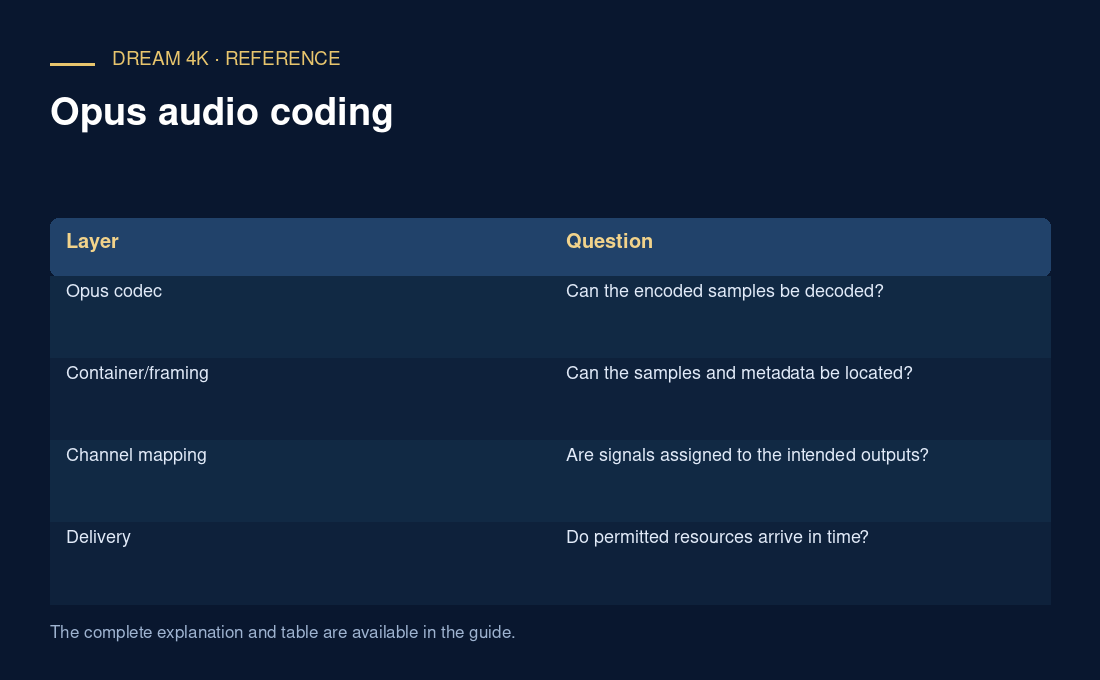
| Layer | Question |
|---|---|
| Opus codec | Can the encoded samples be decoded? |
| Container/framing | Can the samples and metadata be located? |
| Channel mapping | Are signals assigned to the intended outputs? |
| Delivery | Do permitted resources arrive in time? |
| Endpoint | Can the chosen output configuration be reproduced? |
Avoid universal quality or support promises
A codec specification does not establish a fixed perceived quality at every bit rate, a battery result or support in every television app. Encoder settings, content, platform implementation and exact configuration matter.
For a compatibility report, preserve the container, codec declaration, sample/channel details, player version and actual error. A successful modest example adds evidence for that path without certifying a whole platform or catalogue.