
In this guide
Locate the decoder in the chainOutput support is not source support aloneUse a documented reversible comparisonAudio passthrough generally refers to forwarding an encoded audio format through a supported path for a downstream device to decode. In another arrangement, the player decodes audio and outputs PCM. Product settings and supported formats vary, so the application’s exact documentation matters.
Neither arrangement is automatically superior in every setup. The source, player, connection and receiving device must support the selected configuration.
Locate the decoder in the chain
With player decoding, the app/device interprets compressed samples before output. With a supported encoded route, a receiver or soundbar may perform that step. Channel mapping, mixing and processing opportunities can differ along those paths.
An original hypothetical source has an encoded surround track. One player sends multichannel PCM after decoding; another forwards the supported encoded format to a receiver. Both require correct layout and endpoint support. A codec badge at the receiver does not alone prove better sound.
Output support is not source support alone
Android distinguishes compressed direct endpoint output from linear PCM and notes that an endpoint must be capable of decoding the compressed format. Apple’s guidance also ties audio options to connected equipment and content. A television or intermediate device can be part of the path, so checking only the receiver’s product name is incomplete.
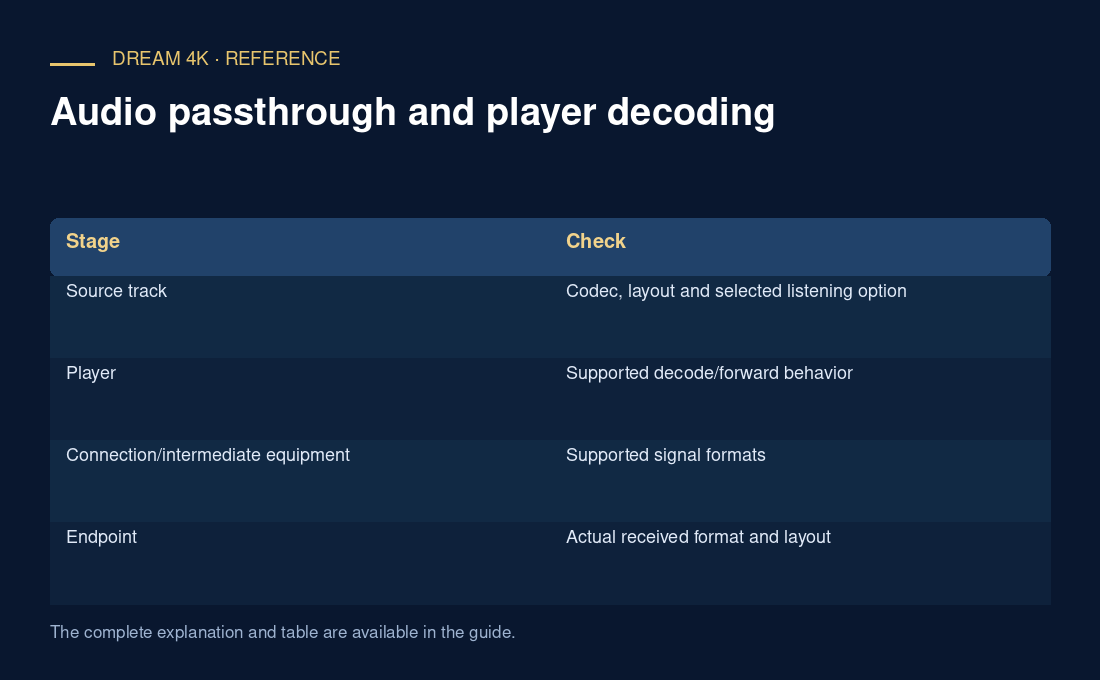
| Stage | Check |
|---|---|
| Source track | Codec, layout and selected listening option |
| Player | Supported decode/forward behavior |
| Connection/intermediate equipment | Supported signal formats |
| Endpoint | Actual received format and layout |
| Result | Sound, errors and channel mapping |
Use a documented reversible comparison
Record the current mode before changing it. If one supported alternative works, retain the exact configuration difference. Silence after enabling passthrough can be a path-support or selection issue rather than proof that the source contains no audio.
Do not recommend a universal passthrough toggle, promise lossless provenance or infer immersive-audio support from a generic surround label. Use exact-model guidance and observed input information for a concrete conclusion.