
In this guide
Labels and ordering are part of the formatConversion may require a deliberate remappingUse a known labelled signal for diagnosisChannel count says how many audio signals are represented. Channel layout assigns meaning or positions to those signals. Two formats can carry the same count while using different channel ordering or mapping conventions.
A correct playback path must interpret the layout and connect it to the supported endpoint configuration. A picture with some sound does not prove that every intended channel is arriving at the correct speaker.
Labels and ordering are part of the format
Stereo conventionally distinguishes left and right. Surround layouts add other positions and can include a low-frequency-effects signal. The .1 notation is not a count of all physical subwoofers in a room, and a receiver can redistribute bass according to its own documented speaker management.
An original hypothetical six-channel buffer contains the intended center signal at a defined position. If another stage assumes a different ordering, that signal can be mapped incorrectly even though six numerical channels remain present.
Conversion may require a deliberate remapping
RFC 7845 explicitly notes that channel ordering in its Ogg Opus surround mapping differs from some other formats. Android channel-position masks likewise associate samples with named endpoint channels. A conversion that preserves samples but changes ordering without the required mapping can produce a wrong spatial result.
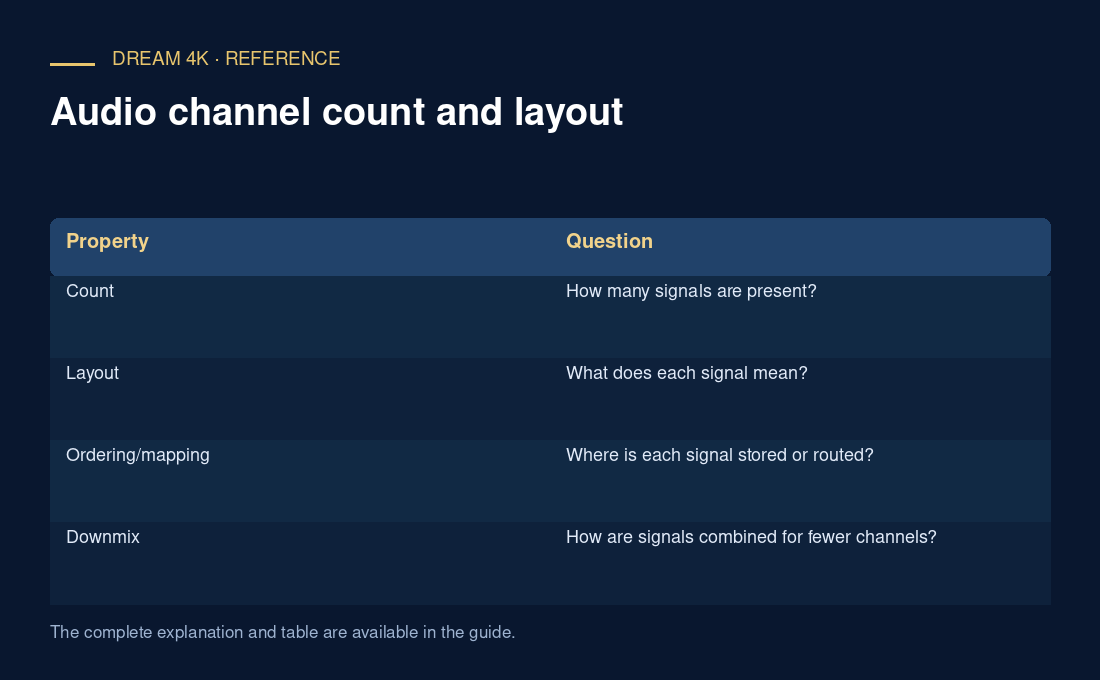
| Property | Question |
|---|---|
| Count | How many signals are present? |
| Layout | What does each signal mean? |
| Ordering/mapping | Where is each signal stored or routed? |
| Downmix | How are signals combined for fewer channels? |
| Speaker configuration | What endpoints are actually available? |
Use a known labelled signal for diagnosis
Music or an unfamiliar scene is an uncertain channel test because its mix may not use every position. A permitted labelled identification source can reveal which intended channel is heard where. Record the source layout, output format and receiver configuration.
A missing channel can involve selection, mapping, downmixing, connection or speaker configuration. The observation narrows the path but does not identify a defective component without further evidence.