
In this guide
Keep the units and channel contextResampling changes representation, not programme durationA higher number is not a complete quality verdictAudio sample rate describes the number of samples per channel per second. It is expressed in hertz. A rate of 48 kHz means 48,000 samples per channel each second in the represented audio timeline.
This is different from an encoded bit rate such as 128 kbit/s. Sample rate, sample representation, channel count and compression jointly describe different aspects of the audio.
Keep the units and channel context
An original hypothetical stereo signal at 48 kHz has 48,000 sample instants per second for each of its two channels. A complete audio frame in common API terminology includes the corresponding samples for all channels. Counting every channel sample as a separate second would confuse the timeline.
For uncompressed integer PCM, a simple payload-rate calculation multiplies sample rate, bits per sample and channels. Compressed formats do not follow that raw-size formula directly because their coding changes the stored/transmitted representation.
Resampling changes representation, not programme duration
A playback system can convert between content and endpoint sample rates. Android explicitly distinguishes the media sample rate from the rate at which the endpoint renders it; supported conversion does not simply play an 8 kHz source six times faster on a 48 kHz endpoint.
Correct resampling differs from falsely relabelling samples with another rate. The former constructs an appropriate representation on the intended timeline; the latter can change the interpreted speed and pitch.
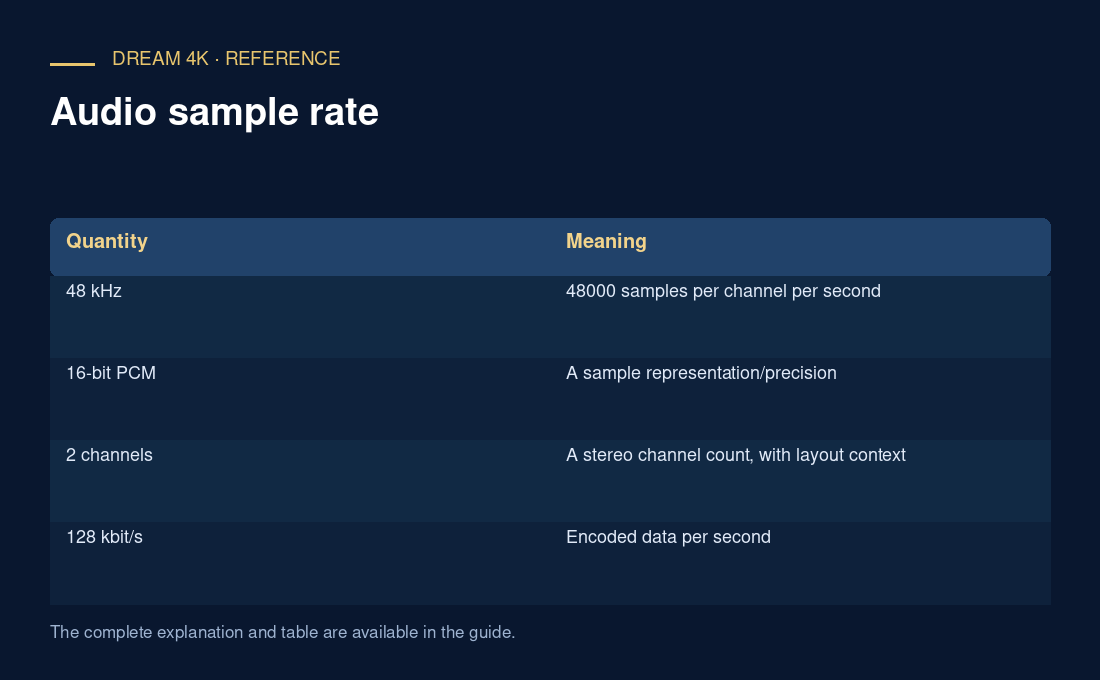
| Quantity | Meaning |
|---|---|
| 48 kHz | 48000 samples per channel per second |
| 16-bit PCM | A sample representation/precision |
| 2 channels | A stereo channel count, with layout context |
| 128 kbit/s | Encoded data per second |
| Endpoint rate | The active output processing rate |
A higher number is not a complete quality verdict
Source recording, filtering, compression, processing and playback path affect the result. Converting a limited source to a higher sample rate does not recreate absent captured information. A sample-rate label also does not establish lossless coding or a particular speaker arrangement.
For diagnosis, preserve source rate, codec, channels, endpoint and exact player behavior. A support claim should follow current platform/device documentation rather than assuming every rate is supported in every application.