
Network latency describes delay between defined points. A one-way delay measures travel in one direction; round-trip time includes a journey out and a response back. Neither quantity is the same as throughput or the full delay between a live event and its appearance on a screen.
For streaming, latency can affect connection setup, request response time and interactions. Sustained playback also depends on how quickly media is delivered after those requests begin.
The measurement path matters
A ping result usually measures an ICMP exchange with one destination. Media may use a different host, route, protocol and server processing path. A low ping to a nearby resolver or gateway therefore cannot establish the round-trip behavior of the media endpoint.
One-way delay measurement additionally depends on timing accuracy between endpoints. Without synchronized clocks and a stated method, subtracting timestamps from two unrelated machines can produce a misleading result.
An original comparison
Suppose path A has a 10-millisecond round trip but delivers a large segment slowly after the response begins. Path B has a 40-millisecond round trip but transfers that segment quickly. The first path can be more responsive for a tiny exchange yet less useful for sustained media delivery during the observed interval.
These are illustrative conditions, not a ranking of network types. Request concurrency, connection reuse, congestion control and application scheduling influence the actual playback result.
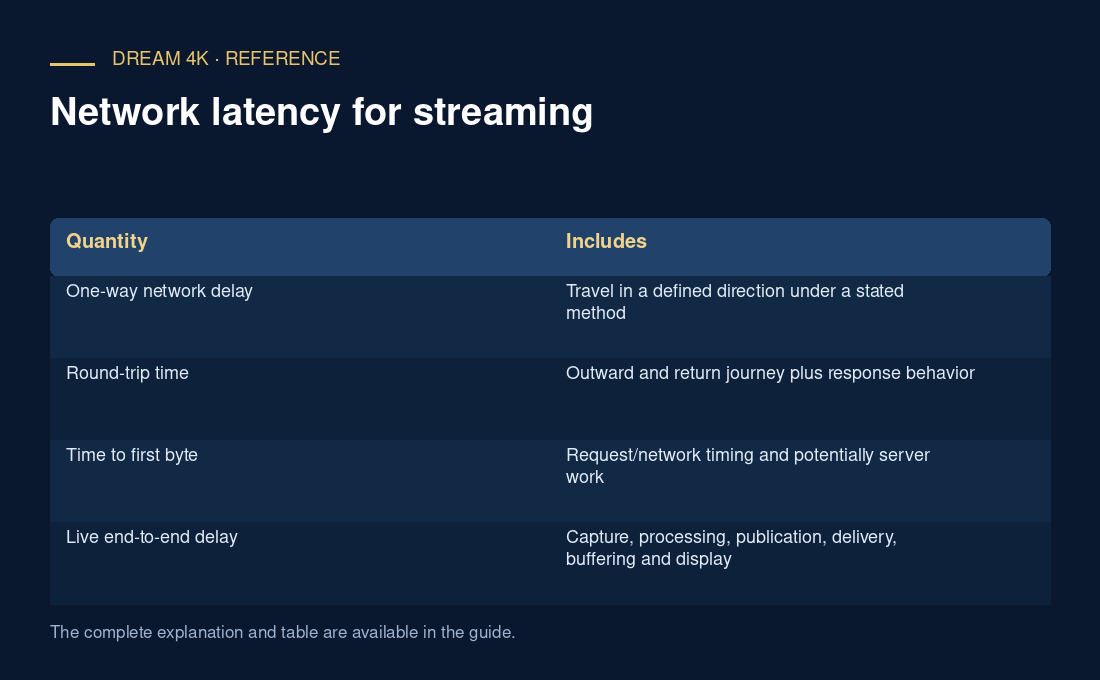
| Quantity | Includes |
|---|---|
| One-way network delay | Travel in a defined direction under a stated method |
| Round-trip time | Outward and return journey plus response behavior |
| Time to first byte | Request/network timing and potentially server work |
| Live end-to-end delay | Capture, processing, publication, delivery, buffering and display |
Use latency as one part of evidence
Record the destination, packet type, sample period and whether the network was idle or busy. A rising round-trip time during an upload can reveal queueing that an idle measurement misses. A playback spinner without these observations is not a latency measurement.
Avoid a universal ping threshold for video quality. Different applications, buffers and live-delay goals tolerate delay differently. The evidence should identify which delay was measured and which part of the playback problem it could plausibly affect.