
In this guide
Freshness and validation have distinct jobsDirective names need their defined meaningsCapture evidence before clearing cachesHTTP caches store eligible responses and can reuse them according to freshness, validation and other protocol rules. Streaming systems can use caches for playlists, initialization data and media resources, but those resources do not all have the same update pattern.
A live playlist changes while many published media objects remain fixed. Cache policy needs to reflect those roles. A cached response’s age is also different from how long the source retains media for replay.
Freshness and validation have distinct jobs
A fresh stored response can be reused when the applicable rules allow it. A stale response can require validation or another permitted treatment. Validators such as entity tags let a client check whether its stored representation can be reused without transferring the full body again.
An original hypothetical live playlist is stored with a policy allowing a long reuse interval while new segments are published more frequently. A client can receive an older validly stored view during that interval. Whether that policy is appropriate for the presentation is an authoring/delivery question, not proof that the client’s broadband is slow.
Directive names need their defined meanings
No-cache does not simply mean “never store anything”: it requires the relevant validation before reuse under its rules. No-store restricts storage. Private and public address cache eligibility contexts. Read the actual directive and request/response scope rather than inferring behavior from an informal label.
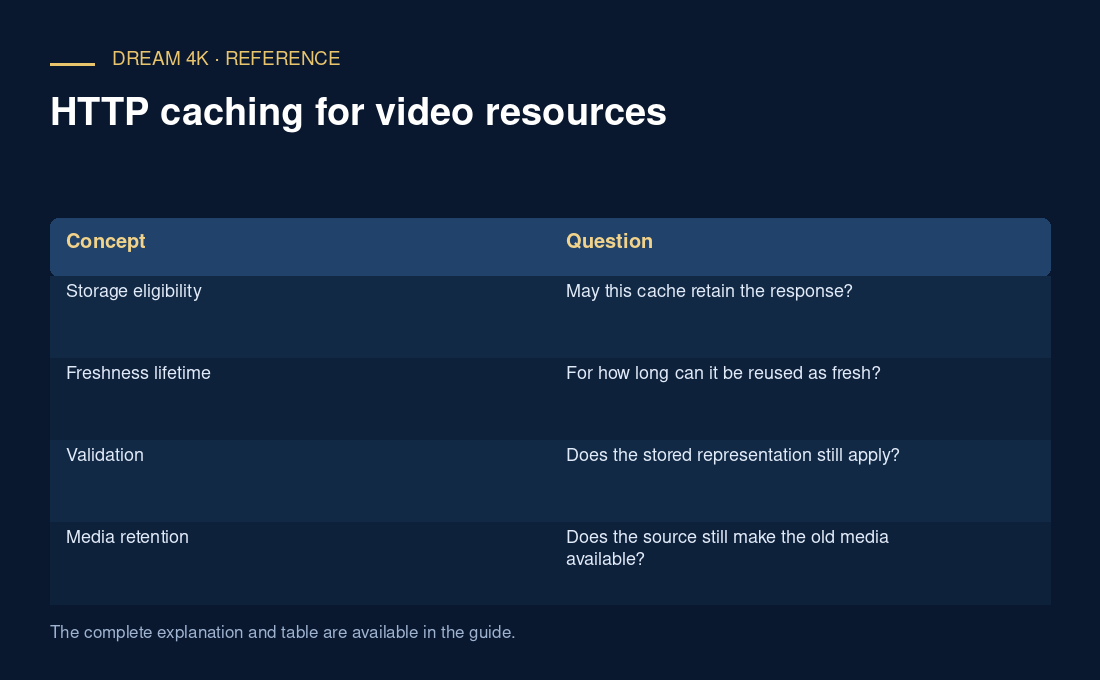
| Concept | Question |
|---|---|
| Storage eligibility | May this cache retain the response? |
| Freshness lifetime | For how long can it be reused as fresh? |
| Validation | Does the stored representation still apply? |
| Media retention | Does the source still make the old media available? |
| Player buffer | Which playable data is already local? |
Capture evidence before clearing caches
Record response headers, retrieval time and the playlist’s newest media reference where diagnostics permit. Clearing an application cache changes the state and can erase the stale-response contrast. It is a possible documented troubleshooting action, not a root-cause diagnosis.
For authenticated resources, follow correct cache and credential policies. Do not expose private responses or defeat access rules to test reuse.