
In this guide
Ranges have starts and endsBuffering is separate from seekingInterpret buffer evidence in contextA browser media element’s buffered property reports time ranges of media currently buffered by the user agent. It is a snapshot of intervals, not a single universal “percent downloaded” number. Seeking, eviction and segmented loading can produce multiple ranges.
The range containing the current playback position matters when estimating immediately available media. A large buffered range elsewhere in the programme does not fill a gap directly ahead of the current position.
Ranges have starts and ends
A TimeRanges object exposes a range count and start/end values for each interval. Check the count before reading an index. The object returned from buffered is static, so a later observation requires reading the property again rather than expecting an earlier snapshot to update itself.
An original hypothetical snapshot contains ranges 0–30 seconds and 60–90 seconds, with playback at 20 seconds. There are ten buffered seconds ahead in the current interval, not seventy. Subtracting currentTime from the last range’s end would incorrectly count the unbuffered gap.
Buffering is separate from seeking
The seekable property describes positions the user agent can seek to. A position can be seekable without already being buffered, because the player may be able to retrieve it on demand. Conversely, media held locally can have a different lifetime from the source’s advertised live window.
A player interface may simplify these details into one bar. That visual is useful for the viewer but should not be treated as a precise map without knowing what it represents.
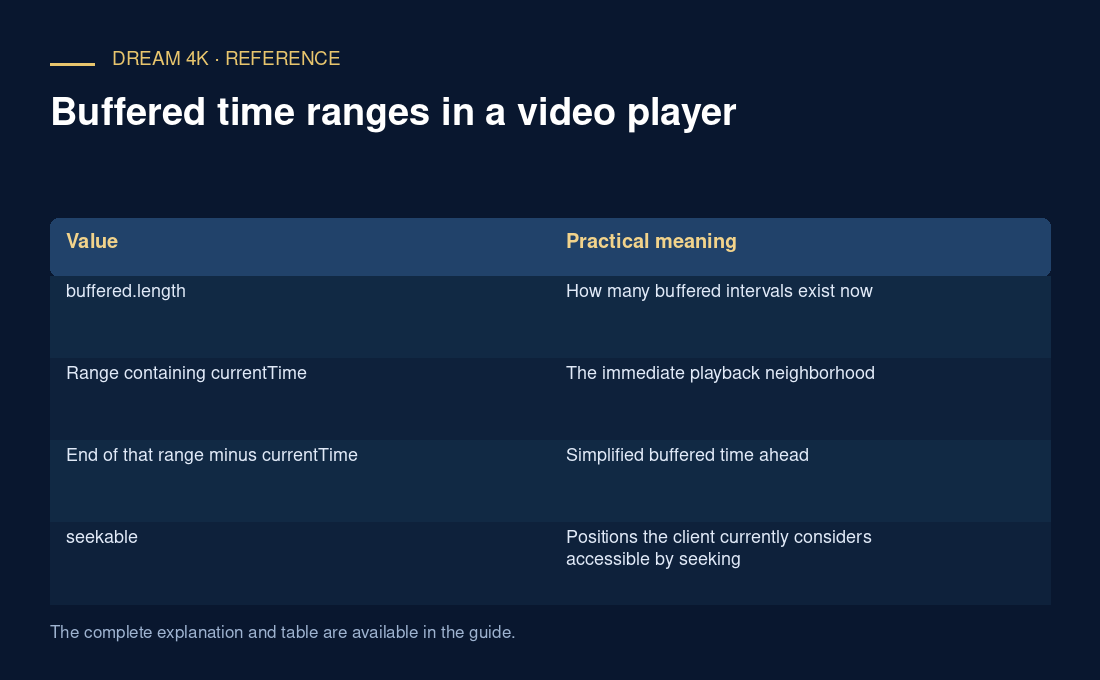
| Value | Practical meaning |
|---|---|
| buffered.length | How many buffered intervals exist now |
| Range containing currentTime | The immediate playback neighborhood |
| End of that range minus currentTime | Simplified buffered time ahead |
| seekable | Positions the client currently considers accessible by seeking |
Interpret buffer evidence in context
A shrinking current interval during late requests supports a delivery-deadline investigation. A substantial buffered interval with a frozen picture suggests examining parsing, decoding or presentation as well. Buffered data is not a guarantee that every sample will decode successfully.
For developers, observe the existing player without changing its media source or eviction policy merely to collect a number. For viewers, use a documented diagnostics panel where available. This reference describes a browser API, not a claim that every television application exposes it.