
In this guide
Read the actual response rather than the spinnerA code narrows the question, not every causeRetry with context and restraintAn HTTP status code describes the outcome of a request at the HTTP layer. A streaming session makes many requests, so the useful evidence pairs the code with the resource role, observation time and selected playback context.
A playlist, audio track, initialization resource and media segment can return different outcomes. One successful response does not cancel another dependency’s failure.
Read the actual response rather than the spinner
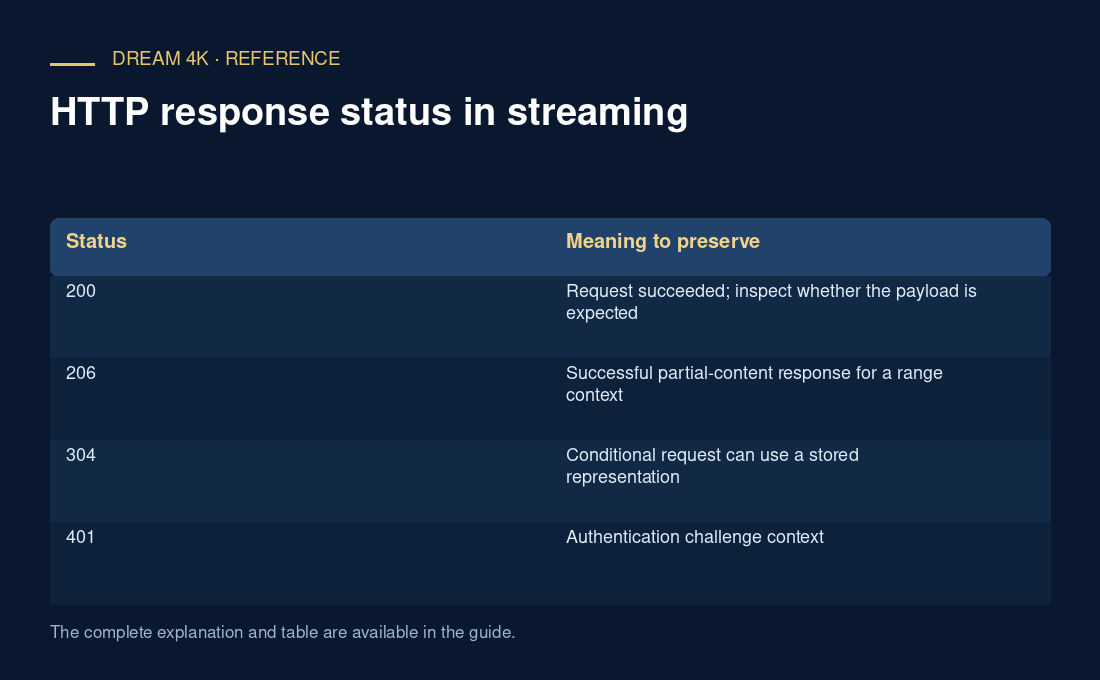
| Status | Meaning to preserve |
|---|---|
| 200 | Request succeeded; inspect whether the payload is expected |
| 206 | Successful partial-content response for a range context |
| 304 | Conditional request can use a stored representation |
| 401 | Authentication challenge context |
| 403 | Server refuses to fulfill the request |
| 404 | Target resource not found under response semantics |
| 429 | Too many requests under the server policy |
| 503 | Service temporarily unavailable; Retry-After may be supplied |
A code narrows the question, not every cause
A 403 does not uniquely prove that an account expired. A 404 for an old live segment differs from a current playlist referencing a missing segment. A 503 does not establish the duration or scope of an outage. Preserve explanatory response details where safe, but do not treat a generic error page as authoritative account policy.
An original hypothetical session receives 200 for the media playlist and 404 for one listed segment. The narrow observation is a failed resource within a published chain. Calling every endpoint down would overstate the evidence.
Retry with context and restraint
Follow the application’s documented retry behavior and any applicable Retry-After information. Rapid repeated requests can add load or prolong rate-limit trouble. A 429 is not a reason to rotate identities or evade the server’s controls.
Capture the earliest relevant failed request, redacted path, status, time and whether adjacent resources worked. If no HTTP response was received, say so: DNS, connection or TLS failures occur at a different stage. A numeric response is useful precisely because it should not be replaced by an unsupported explanation.