
In this guide
Separate connection establishment from response semanticsPreserve media dependencies as usualCompare versions only through a supported mechanismHTTP/3 changes the transport mapping, not the basic meaning of HTTP requests and responses. A media request can use QUIC successfully and still receive an authorization, missing-resource or service-unavailable response.
When a player reports an HTTP/3 problem, first establish whether the failure happened before an HTTP response or was an actual response from the serving system. That distinction directs the investigation.
Separate connection establishment from response semantics
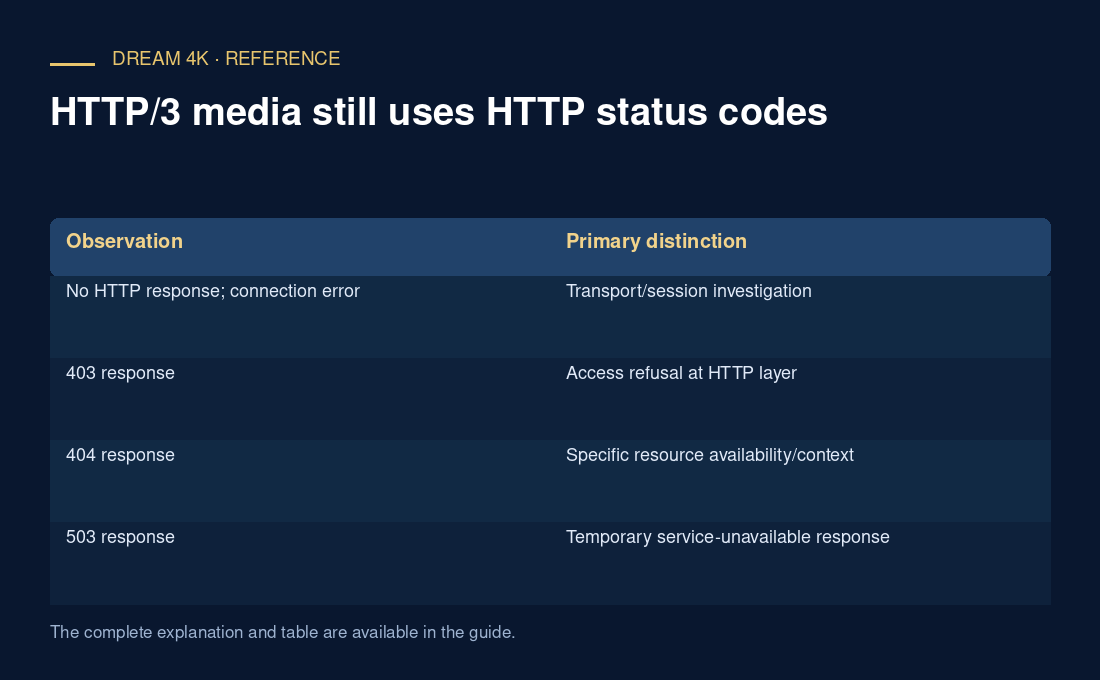
A failure to establish or sustain the secure QUIC connection is transport evidence. A received 403 or 404 is application-layer evidence that a server processed the request far enough to return that status. Record the exact error rather than flattening both into “UDP blocked.”
In an original hypothetical session, a video segment returns 404 over HTTP/3 while another resource on the same connection returns 200. That pattern does not establish a general inability to carry QUIC. It points first to the specific resource response and its playlist context.
Preserve media dependencies as usual
Trace entry playlists, selected renditions, initialization sections and media resources just as you would for another HTTP version. A successful playlist does not guarantee all later dependencies. A response carrying an unexpected HTML page is still unsuitable media even over a functioning modern transport.
For live media, compare whether the failed segment was current in the playlist at request time. An expired old position can fail under any supported HTTP transport version. The protocol label does not resolve the source-retention question.
Compare versions only through a supported mechanism
If a browser or application legitimately negotiates or falls back between versions, record which version was actually used and the outcome. Do not disable security or install unknown network tools to force a comparison. A change in protocol can coincide with a different connection, address or cache path, so retain those limitations.
A useful report states transport error or HTTP status, resource role, observation time, selected media configuration and player version. It can identify a reproducible version-sensitive case without claiming that HTTP/3 always improves video or that one failure proves a whole UDP path is unusable.
| Observation | Primary distinction |
|---|---|
| No HTTP response; connection error | Transport/session investigation |
| 403 response | Access refusal at HTTP layer |
| 404 response | Specific resource availability/context |
| 503 response | Temporary service-unavailable response |
| 200 but invalid media | Payload/format investigation |