
In this guide
Resolution, dynamic range and codec are separate axesConfiguration determines the support questionAvoid fixed savings or quality guaranteesHEVC, also known as H.265, is a video coding standard. Its purpose includes efficient representation of moving pictures across applications such as streaming and broadcasting. It is distinct from a container format and from a display’s pixel dimensions.
HEVC is often encountered alongside UHD or HDR media, but those associations are not identities. The codec name alone does not prove that a source is 4K, that it uses HDR, or that an exact device/player path supports its configuration.
Resolution, dynamic range and codec are separate axes
A presentation can use HEVC at different resolutions and with different image characteristics. HDR interpretation also requires appropriate transfer, colour and signalling information. A display showing an HDR badge does not by itself identify the codec used upstream.
An original hypothetical pair contains 1080p HEVC video in one item and 4K video encoded by another supported codec in a second item. The first is still HEVC without being 4K; the second is still 4K without being HEVC. The example illustrates independent attributes, not a compatibility promise.
Configuration determines the support question
Profile, level, tier, bit depth, chroma format, frame rate and packaging can affect requirements. The player may use device decoders and platform media APIs, so support depends on the complete path. A generic HEVC logo is insufficient evidence for a demanding operating point.
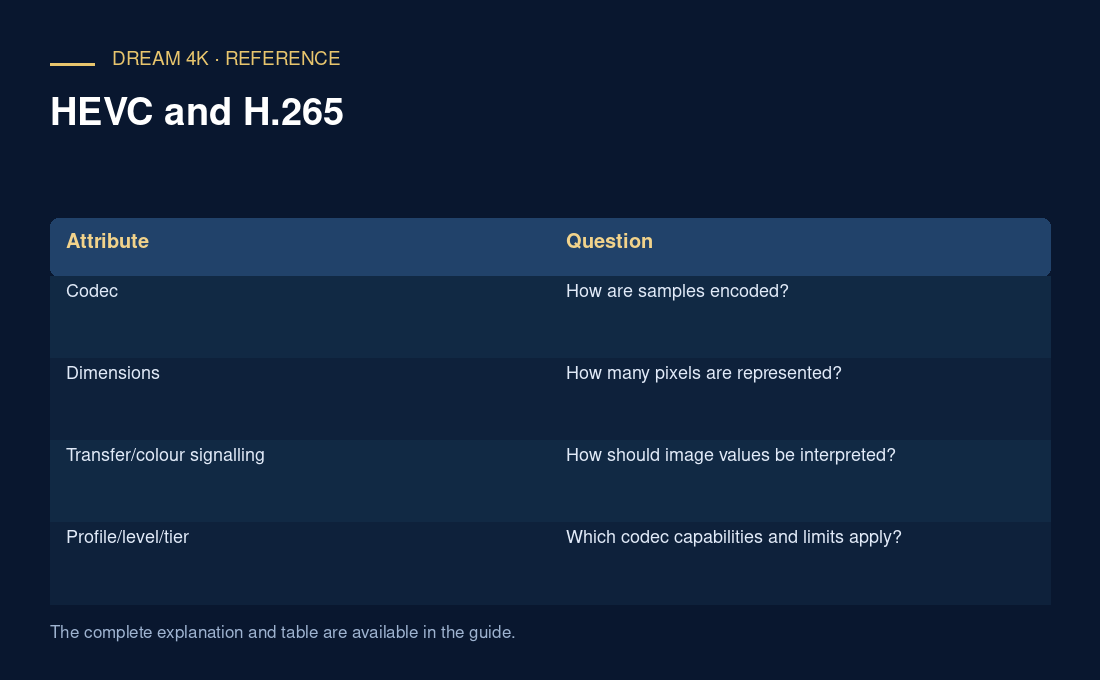
| Attribute | Question |
|---|---|
| Codec | How are samples encoded? |
| Dimensions | How many pixels are represented? |
| Transfer/colour signalling | How should image values be interpreted? |
| Profile/level/tier | Which codec capabilities and limits apply? |
| Player/device path | Can this configuration be handled here? |
Avoid fixed savings or quality guarantees
Compression outcomes depend on content, encoder choices and the comparison method. Do not infer an exact percentage reduction or better picture from the codec name alone. A badly encoded higher-resolution stream can still look worse than a well-encoded lower-resolution one.
For support, preserve the complete codec declaration and actual selected metadata. If another rendition works, describe its differences precisely rather than assuming HEVC itself is the sole changed variable.