
In this guide
The family name leaves important details openKeep video, audio and delivery independentUse the exact context for a support checkH.264, also called AVC, is a video coding standard used across many audiovisual applications. It describes encoded video, not a file container, a streaming subscription or an audio format. The ITU recommendation is paired with the corresponding ISO/IEC video coding standard.
Its widespread use does not make every H.264 bitstream equivalent. Profiles, levels and other encoded characteristics affect the requirements placed on a decoder.
The family name leaves important details open
An H.264 presentation can differ in dimensions, frame rate, bit rate, profile, level, bit depth and other characteristics. The container and delivery method add their own requirements. A player that parses one MP4/H.264 file has demonstrated one configuration, not universal support for every H.264 stream.
An original hypothetical comparison uses two H.264 renditions: one modest 720p example and one substantially more demanding configuration. If the first plays, the result establishes that path for that media. It does not automatically answer whether the second fits the decoder’s documented operating limits.
Keep video, audio and delivery independent
A source can pair H.264 video with different audio formats and package it in different structures. A silent picture can therefore be an audio-path issue rather than a failure of H.264 decoding. Likewise, a playlist access error occurs before the video codec can be meaningfully tested.
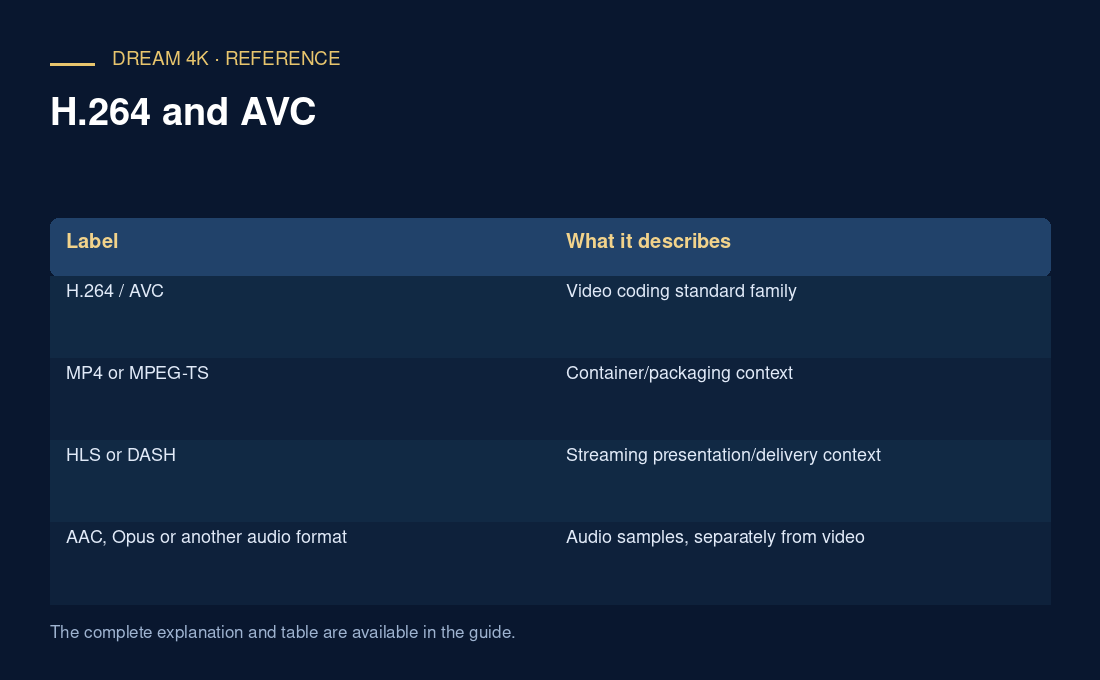
| Label | What it describes |
|---|---|
| H.264 / AVC | Video coding standard family |
| MP4 or MPEG-TS | Container/packaging context |
| HLS or DASH | Streaming presentation/delivery context |
| AAC, Opus or another audio format | Audio samples, separately from video |
| avc1… declaration | A registered description with more configuration detail |
Use the exact context for a support check
Consult the current player and device documentation for the required configuration. Record the complete codec string and selected track rather than shortening the issue to a codec nickname. Browser capability hints and controlled playback can add evidence, but neither establishes a provider’s whole catalogue or every device model’s behavior.
A codec standard defines how media is represented. It does not guarantee picture quality at an arbitrary bit rate or fix a delivery, timing or display problem.