
In this guide
Transfer interpretation changes the pictureTone mapping and signalling are different jobsCheck exact supported pathsHigh dynamic range video uses an image system with defined relationships between encoded values and intended light. ITU-R BT.2100 specifies HDR television parameters using PQ and HLG approaches. Their transfer characteristics are not interchangeable labels for the same curve.
Correct presentation depends on source metadata, decoding, output signalling and display interpretation. A codec name or ten-bit label alone does not establish that this chain is correct.
Transfer interpretation changes the picture
The same numerical code value can imply different intended light behavior under different transfer systems. If a stage treats one system as another, the result can look too dark, washed out or otherwise incorrect. The visible symptom is a clue, not proof of one specific metadata fault.
An original hypothetical source is intended for an HDR transfer system while a downstream stage treats it as ordinary SDR without an appropriate conversion. A brightness slider can change the appearance but does not by itself establish correct transfer interpretation.
Tone mapping and signalling are different jobs
Tone mapping adapts content to a target display capability or presentation range. Signalling tells stages how the media should be interpreted. A display with different capabilities can legitimately produce a different appearance, but missing or wrong signalling is a separate interoperability question.
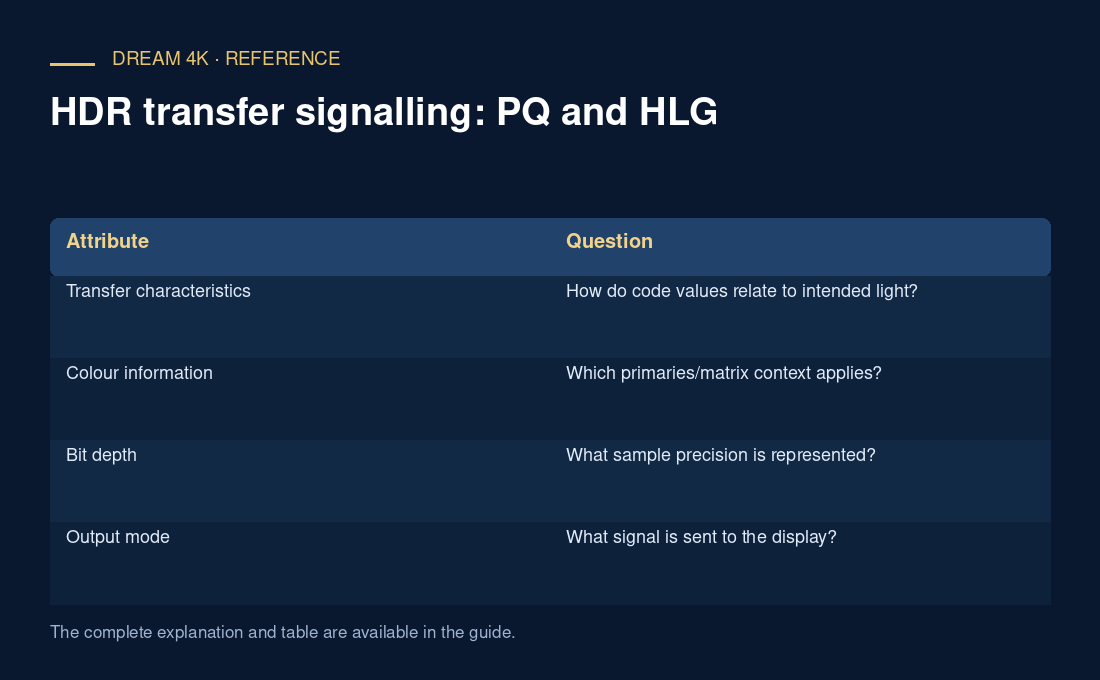
| Attribute | Question |
|---|---|
| Transfer characteristics | How do code values relate to intended light? |
| Colour information | Which primaries/matrix context applies? |
| Bit depth | What sample precision is represented? |
| Output mode | What signal is sent to the display? |
| Display handling | How is the supported input interpreted/adapted? |
Check exact supported paths
A device can offer content matching or fixed output modes. Apple documents dynamic-range matching independently from frame-rate matching, and available formats depend on the display path. Use current exact-model guidance for other platforms.
When reporting an HDR issue, record the source declaration if known, selected rendition, device output, receiver/display chain and observed mode. Do not infer HDR availability, peak brightness or accurate calibration from a service badge. These require their own evidence.