
In this guide
Source history still mattersRepresentation and output can change laterPreserve technical metadataFLAC is a lossless audio coding format. For supported input and correct encoding/decoding, it preserves the represented audio samples rather than discarding information through lossy coding. RFC 9639 defines the format and its streamable subset.
Lossless describes the coding relationship to the input samples. It does not prove the quality of the original recording, the absence of earlier lossy processing or the behavior of every later output stage.
Source history still matters
A noisy recording remains noisy when stored losslessly. Samples produced by decoding a lossy file can be preserved in FLAC, but that does not recreate information discarded before those samples existed. File size and a lossless label are therefore not complete quality evidence.
An original hypothetical MP3 is decoded to PCM and then encoded as FLAC. The FLAC can preserve that decoded PCM correctly while retaining the consequences of the earlier MP3 coding. It is lossless relative to its immediate input, not a restoration of the pre-MP3 source.
Representation and output can change later
A player can decode FLAC, resample, adjust volume, mix channels or route PCM to an endpoint. Those are separate operations. A FLAC filename does not certify that the final electrical or acoustic output is identical to an earlier source.
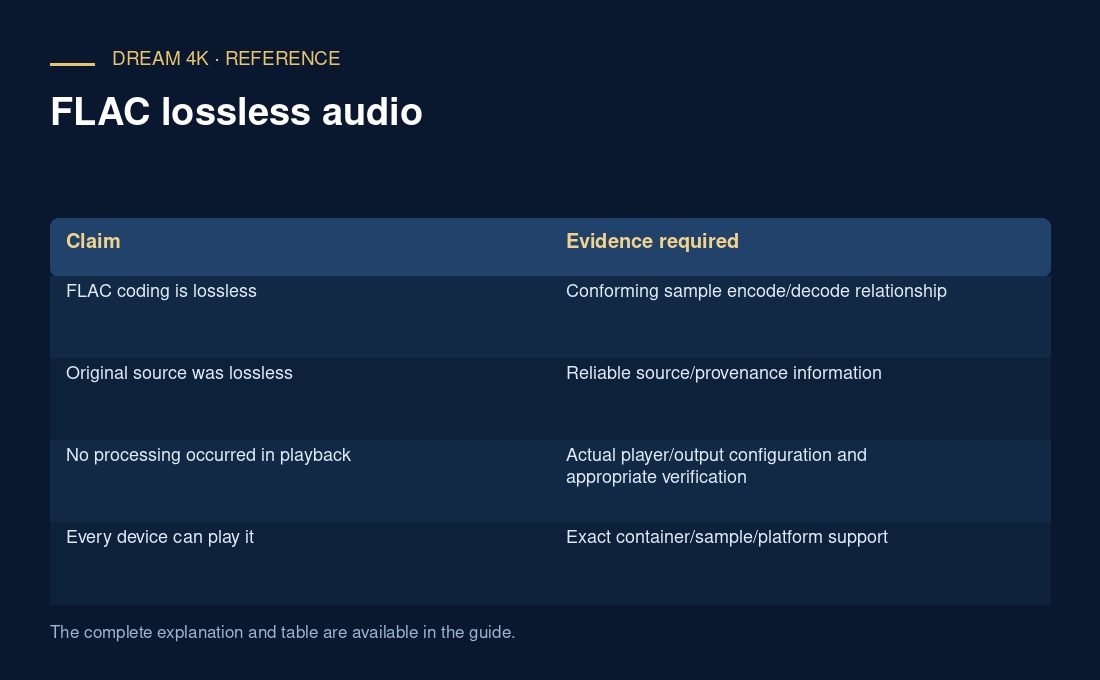
| Claim | Evidence required |
|---|---|
| FLAC coding is lossless | Conforming sample encode/decode relationship |
| Original source was lossless | Reliable source/provenance information |
| No processing occurred in playback | Actual player/output configuration and appropriate verification |
| Every device can play it | Exact container/sample/platform support |
| It sounds better than another file | A defined fair comparison, not the suffix alone |
Preserve technical metadata
Record sample rate, precision, channel layout and applicable container context. Integrity mechanisms in a format help detect particular inconsistencies but should not be confused with a blanket authenticity or security guarantee.
For compatibility, use current platform/player documentation and a controlled observation of the actual configuration. Do not infer a streaming service’s catalogue, bit-perfect output or guaranteed listening quality from its use of FLAC.