
In this guide
The identifier belongs to a defined syntaxDo not decode every identifier by visual similarityMetadata is a claim to verifyA codec string is a structured identifier used in media metadata to describe encoded sample formats and, where applicable, configuration details. It can appear in a MIME codecs parameter or in streaming manifest declarations.
A codec-family nickname such as H.264 or AV1 is less specific than the complete declaration. Preserving the original string helps developers compare what was advertised with what the player selected and what the resource actually contains.
The identifier belongs to a defined syntax
RFC 6381 explains a codecs parameter for applicable media types and a hierarchical naming model. Different codec registrations define their own detailed syntax. A comma-separated list can describe several track formats in one media type; its quoting and punctuation matter.
An original hypothetical declaration contains both a video identifier and an audio identifier. Removing the audio identifier to make a shorter report changes the description of the combination the player was asked to render. This is why screenshots that cut off the end of a codec list can lose useful evidence.
Do not decode every identifier by visual similarity
Prefixes and numeric fields are not universal across codec families. A hexadecimal field in one format should not be read as a decimal frame rate or bit rate. Consult the relevant registration or specification before interpreting a profile, level, tier or bit-depth field.
Likewise, two related sample-entry names can carry packaging or parameter-set semantics that should not be erased by replacing both with a generic codec name.
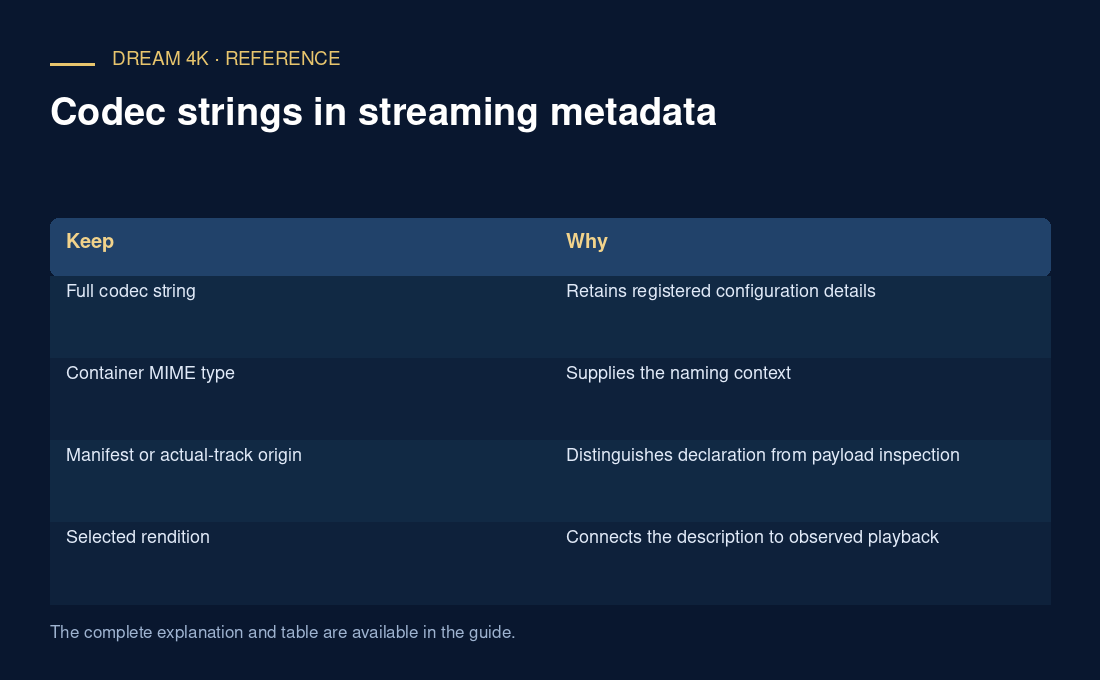
| Keep | Why |
|---|---|
| Full codec string | Retains registered configuration details |
| Container MIME type | Supplies the naming context |
| Manifest or actual-track origin | Distinguishes declaration from payload inspection |
| Selected rendition | Connects the description to observed playback |
Metadata is a claim to verify
A correct-looking codec declaration does not prove the payload conforms to it or that every client supports the configuration. Inaccurate metadata can mislead source selection before decoding begins. For an authoring issue, preserve the manifest declaration and the actual track analysis separately.
A useful support report includes the exact string as text, the player version and the observed error. Avoid replacing it with a marketing quality label, because resolution and codec configuration answer different questions.