
In this guide
More code values can support finer gradationsKeep the attributes separateTen-bit is not a complete HDR or support claimBit depth describes the number of bits used to represent a component sample under a video format’s rules. Eight bits provide 256 possible code values; ten bits provide 1,024. That is four times as many code values per component, not four times the resolution or frame rate.
The usable range and interpretation depend on the representation and signalling. Bit depth should therefore be recorded alongside colour, transfer, chroma and codec information.
More code values can support finer gradations
Quantization divides a range into discrete values. Additional depth can represent smaller steps in an appropriate pipeline, which can help retain gradients. It does not recover detail that was already discarded in an earlier stage.
An original hypothetical eight-bit source is converted into a ten-bit container representation without new source information. More output codes are available, but the original quantization steps do not automatically become newly captured shades. Processing or dithering can change appearance, yet that is different from recovering the lost source.
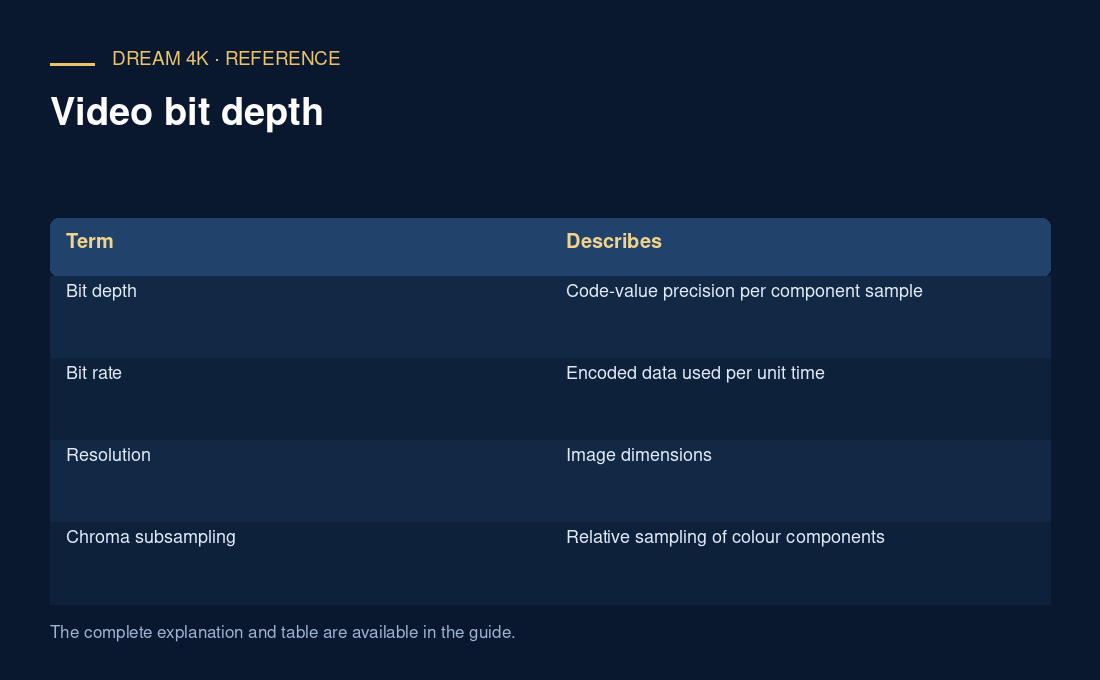
Keep the attributes separate
| Term | Describes |
|---|---|
| Bit depth | Code-value precision per component sample |
| Bit rate | Encoded data used per unit time |
| Resolution | Image dimensions |
| Chroma subsampling | Relative sampling of colour components |
| HDR transfer signalling | How values relate to the intended dynamic-range system |
Ten-bit is not a complete HDR or support claim
A ten-bit stream can be SDR, and an HDR presentation requires appropriate transfer/colour signalling and a suitable playback/display path. A decoder also needs support for the exact codec configuration, not only a familiar family name.
When comparing banding or compatibility, preserve the source configuration and every processing stage you changed. A ten-bit output mode does not prove the source was ten-bit or that the full path retained that precision. A useful report states what was declared, what was selected and what was actually observed.