
In this guide
Use more than one checkpointTime units and edits matterA correction should match the evidenceA subtitle cue occupies an interval on a media timeline. Its start determines when the text becomes active and its end determines when that interval finishes under the format’s rules. Correct wording is not enough if those times refer to a different edit or timing basis.
Timing problems have different shapes. A constant offset shifts cues by roughly the same amount throughout; drift grows or changes over the programme. These observations guide different investigations.
Use more than one checkpoint
Compare a clear spoken event near the beginning and another well later. Record the cue-versus-audio difference at each point. A single checkpoint cannot tell whether the error is constant or accumulating.
An original hypothetical track is two seconds late at minute one and still two seconds late at minute forty. A fixed shift could align those checkpoints if the underlying edit matches. Another track is two seconds late near the start and twelve seconds late later; one constant shift cannot align both.
Time units and edits matter
Formats can express time in different syntaxes or coordinate systems. TTML, for example, defines temporal coordinate options and related parameters. Do not assume a frame-based expression can be interpreted correctly without its frame-rate context. WebVTT uses its own timestamp syntax.
A different programme edit can add or remove scenes, advertisements or opening material. That can produce a sudden change in subtitle alignment rather than a smooth rate drift.
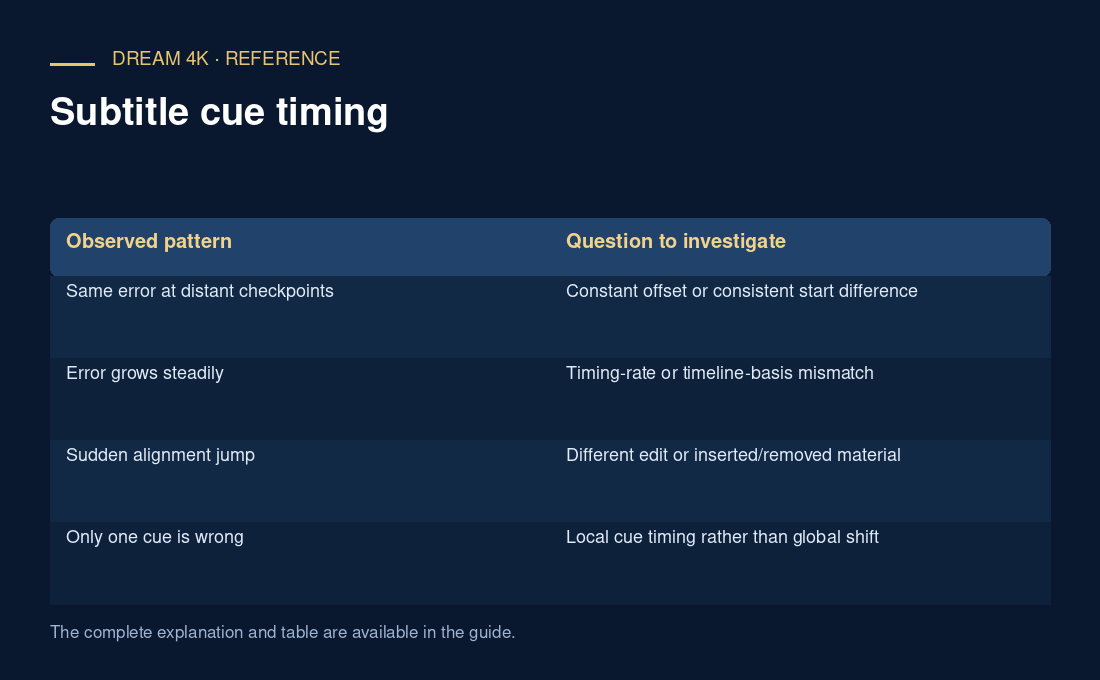
| Observed pattern | Question to investigate |
|---|---|
| Same error at distant checkpoints | Constant offset or consistent start difference |
| Error grows steadily | Timing-rate or timeline-basis mismatch |
| Sudden alignment jump | Different edit or inserted/removed material |
| Only one cue is wrong | Local cue timing rather than global shift |
A correction should match the evidence
If you control the subtitle file, work on a copy and verify multiple checkpoints after any adjustment. A global shift moves every cue equally; a rate conversion changes their relative spacing. Neither automatically repairs a track made for a different edit.
For provider-delivered captions, report exact positions and observed offsets rather than repeatedly applying large local shifts. This identifies the pattern without claiming a cause that the measurements do not establish.