
In this guide
Use a simple original timeline modelMeasure both results with the same referenceChoose a stable supported configurationMoving playback closer to newest available media can reduce one part of live delay, while leaving less time for the next usable media to arrive. A lower displayed delay and fewer pauses are therefore separate outcomes to measure.
Use the application’s documented controls and actual supported source mode. Do not edit a playlist to remove timing context or assume every live stream permits the same position.
Use a simple original timeline model
Suppose the source has published through media time 100 seconds. Client A presents 94, while client B presents 99. Their simplified distances from the published edge are six seconds and one second. If new usable media is late by two seconds, their available timing cushions differ.
This example does not include upstream production or exact client buffering, so it is not a complete latency prediction. It illustrates why the closer position can be more sensitive to a particular deadline even when both clients use the same programme.
Measure both results with the same reference
Record the reference event/clock, selected playback mode, buffer trend and request outcomes before and after a supported change. A programme clock graphic can represent a different production point, so state what it measures. Compare close in time and preserve network/load conditions.
If the source also switches between regular and low-latency publication, that is another changed variable. A player setting, an advertised tag and actual delivery behavior should remain separate observations.
Choose a stable supported configuration
A practical result can be a slightly deeper position that meets the viewer’s continuity needs, but the appropriate choice depends on the source, player and path. Do not prescribe one universal number or promise that a smaller buffer always makes viewing better.
A useful report says the supported mode/position changed, the reference delay changed by an observed amount and pauses or late requests changed in a stated way. If no trustworthy reference exists, report the continuity and position evidence without inventing an end-to-end measurement. This lets the operator investigate timing tradeoffs rather than a vague claim that “low latency is broken.”
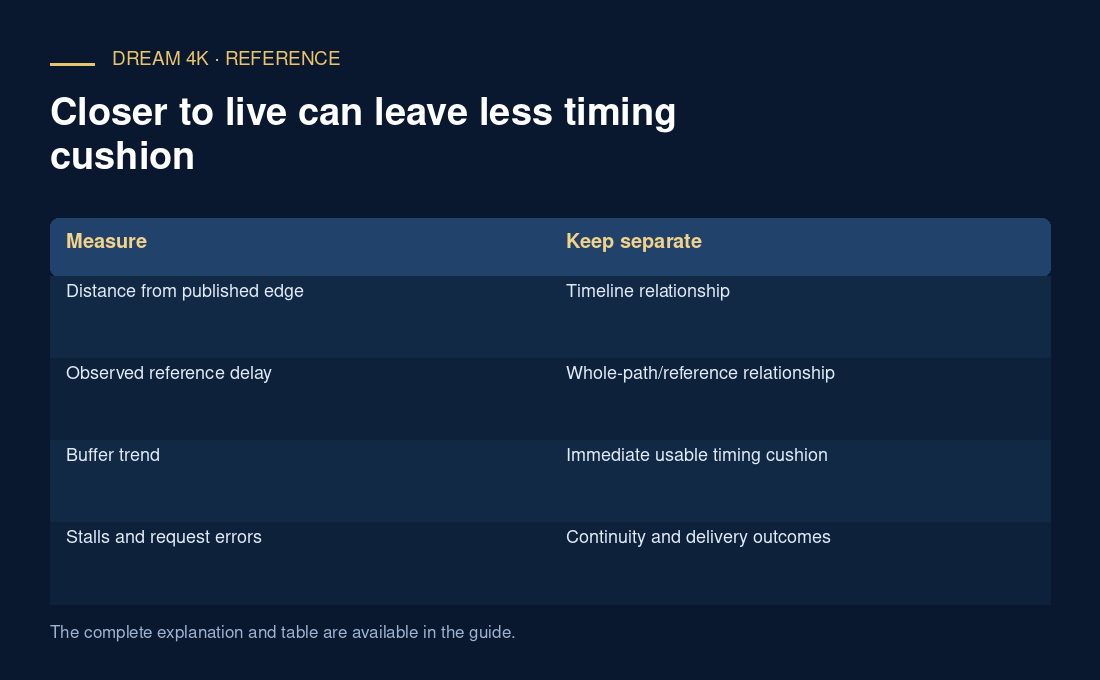
| Measure | Keep separate |
|---|---|
| Distance from published edge | Timeline relationship |
| Observed reference delay | Whole-path/reference relationship |
| Buffer trend | Immediate usable timing cushion |
| Stalls and request errors | Continuity and delivery outcomes |