
In this guide
Streams separate ordering contextsSecurity and network support are part of the pathA newer transport is not an uptime certificateQUIC is a secure transport protocol carried over UDP. It supports multiple streams with reliable, ordered delivery within a stream and integrates transport security. HTTP/3 maps HTTP semantics onto QUIC.
This makes “UDP means the video has no reliability” an incorrect description of HTTP/3 media. The application’s transport semantics come from the full stack, not only the outer datagram protocol.
Streams separate ordering contexts
QUIC can multiplex streams within a connection. Reliability and ordering are applied per stream, which differs from treating every application exchange as one TCP byte stream. This design addresses particular transport interactions, but it does not eliminate congestion, resource limits or media deadlines.
An original hypothetical player retrieves a playlist and several media resources over HTTP/3. Those resources still have HTTP methods, response statuses and payload expectations. A 404 media response remains a resource response; it is not reclassified as a missing UDP datagram.
Security and network support are part of the path
QUIC uses cryptographic handshake and packet protection mechanisms. A real connection still depends on supported clients, servers and network conditions. Do not bypass validation or assume that forcing an unsupported protocol is a safe performance optimization.
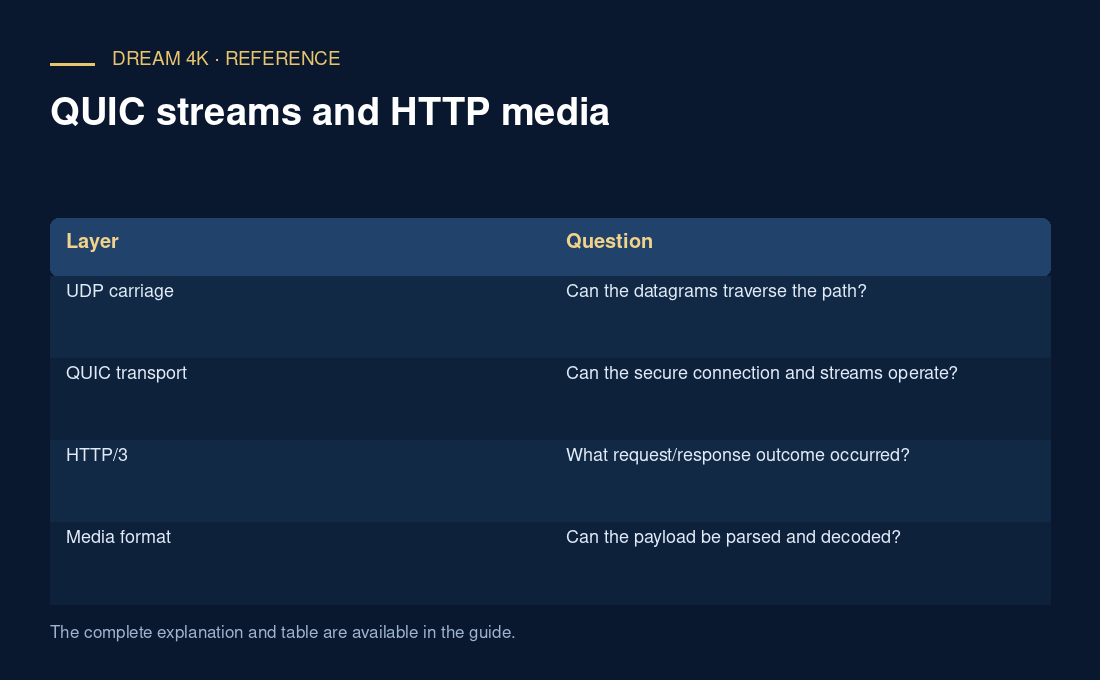
| Layer | Question |
|---|---|
| UDP carriage | Can the datagrams traverse the path? |
| QUIC transport | Can the secure connection and streams operate? |
| HTTP/3 | What request/response outcome occurred? |
| Media format | Can the payload be parsed and decoded? |
| Playback | Did usable media meet its presentation deadlines? |
A newer transport is not an uptime certificate
HTTP/3 support does not guarantee a specific startup time, bitrate or absence of stalls. Encoder output, source publication, cache behavior, media validity, client buffering and display work remain separate. A useful comparison records actual protocol selection and otherwise matched conditions.
When diagnosing a failure, preserve the network error and any HTTP response separately. If a player falls back to another supported version, record the result without assuming that every network or service will use the same negotiation behavior.