
In this guide
A queue is a timing reservoirWhy idle and loaded observations differUse documented management, not random tuningNetwork devices can queue packets when traffic arrives faster than an outgoing link can transmit it. Some queueing is normal. Excessive persistent queues can add substantial delay, a problem often discussed as bufferbloat.
The important observation is delay under load. An idle connection may respond quickly, while the same path becomes much less responsive during an upload or download. High throughput and high queueing delay can occur together.
A queue is a timing reservoir
Packets waiting in a queue have not necessarily been lost. They are delayed before transmission. If an application’s media or control traffic waits behind a large backlog, its request deadlines can suffer even while the link is fully utilized.
An original simplified example places 5 megabytes ahead of a packet on a 10 Mbit/s outgoing link. Ignoring overhead and scheduling details, draining that backlog takes 5 × 8 ÷ 10 = 4 seconds. The example explains serialization of a queue; it is not a model of every router’s scheduling or an estimate of a real home network.
Why idle and loaded observations differ
A lightly used path may have little queued data. A sustained upload can fill a slower upstream link, changing the delay for other traffic. Downloads can also interact with shared resources and acknowledgement traffic. The resulting behavior depends on the path and queue management, not simply on the broadband package name.
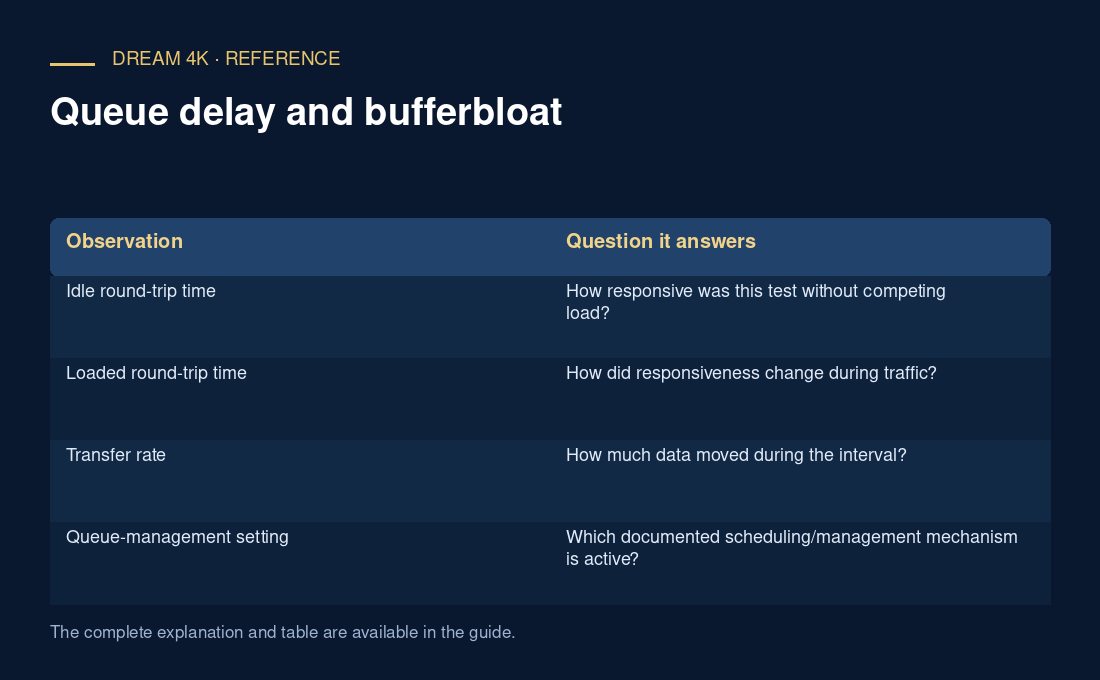
| Observation | Question it answers |
|---|---|
| Idle round-trip time | How responsive was this test without competing load? |
| Loaded round-trip time | How did responsiveness change during traffic? |
| Transfer rate | How much data moved during the interval? |
| Queue-management setting | Which documented scheduling/management mechanism is active? |
Use documented management, not random tuning
IETF guidance recommends active queue management to address harmful queue behavior. Consumer routers may expose related features under manufacturer-specific names. Their configuration and rate settings should follow the router’s current documentation.
Preserve security settings and record the original configuration before a reversible comparison. A loaded-delay result is evidence for investigating queueing; it does not prove that one unnamed feature will fix every stall or that lowering all quality settings is necessary.