
In this guide
Calculate media coverage firstAccount for the stages the playlist does not measurePreserve prerequisites and deadlinesSeeing a 0.3-second part in a playlist does not prove the screen is 0.3 seconds behind the event. The number describes a media interval. Other stages can contribute delay before and after that interval is published.
Use part timing as one component in a stated model, with no service measurement implied. The original example below uses simple values to keep the units clear.
Calculate media coverage first
Suppose a parent interval lasts three seconds and is represented by ten 0.3-second parts. Together the parts cover three seconds. A completed parent segment containing that same interval does not add another three seconds of unique programme content.
If one part takes 0.1 seconds to transfer after it becomes available, that is a request timing observation. It is neither the part’s media duration nor the time from the physical event to publication. Use separate columns rather than subtracting unlike quantities casually.
Account for the stages the playlist does not measure
Capture and production can precede encoding; packaging and publication follow; the client then discovers, requests, buffers and presents media. A display can add processing after decoded frames are ready. A short publication unit can reduce some waiting without eliminating those stages.
A programme clock graphic can also represent a different point in production than the camera exposure. State what reference was used for any end-to-end comparison. A timeline label alone is not a physical capture timestamp.
Preserve prerequisites and deadlines
A part may depend on initialization data and a suitable decoding context. Record the applicable playlist and parent sequence context when diagnosing failure. A small resource arriving quickly does not certify that the player had everything needed to use it.
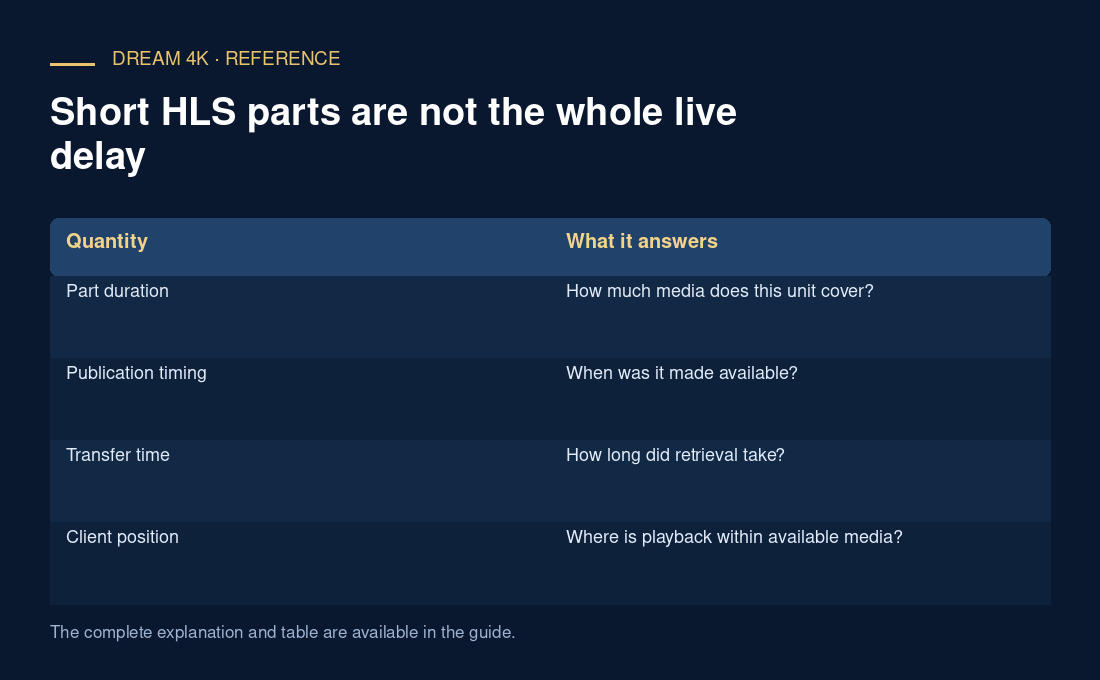
A useful report separates part media duration, request timing, client position and a stated reference-delay observation. It can show a deadline miss or an observed low-delay result without promising that every source with short parts has the same latency or robustness. This precision is especially useful when comparing two clients that choose different distances from the live edge.
| Quantity | What it answers |
|---|---|
| Part duration | How much media does this unit cover? |
| Publication timing | When was it made available? |
| Transfer time | How long did retrieval take? |
| Client position | Where is playback within available media? |
| Reference comparison | What total delay was actually observed? |