
In this guide
A validator links the comparison to stored stateValidation is not a promise that live media advancedPreserve request and response togetherAn HTTP conditional request asks the server to apply a condition before sending or acting on a representation. For ordinary cache validation, a client can send a validator associated with its stored response. A 304 Not Modified response tells it to reuse the applicable stored representation under the protocol’s rules.
The response does not contain a fresh copy of the media body. That absence is expected in a valid validation exchange, not automatically a broken download.
A validator links the comparison to stored state
An entity tag can identify a representation version for conditional checks. Last-Modified information can support time-based conditions where appropriate. The exact semantics and precedence come from HTTP, not from interpreting an arbitrary date as the age of the video programme.
An original hypothetical client stores a playlist with an entity tag, then asks whether that version still applies. The server returns 304. The client uses its stored body with updated response information as required; it should not attempt to parse an empty 304 body as a new playlist.
Validation is not a promise that live media advanced
A valid 304 says the stored representation can be reused for that request. It does not promise that a live source has published new content or that every referenced segment remains accessible. An unchanged live playlist may be legitimate or may need separate publishing investigation.
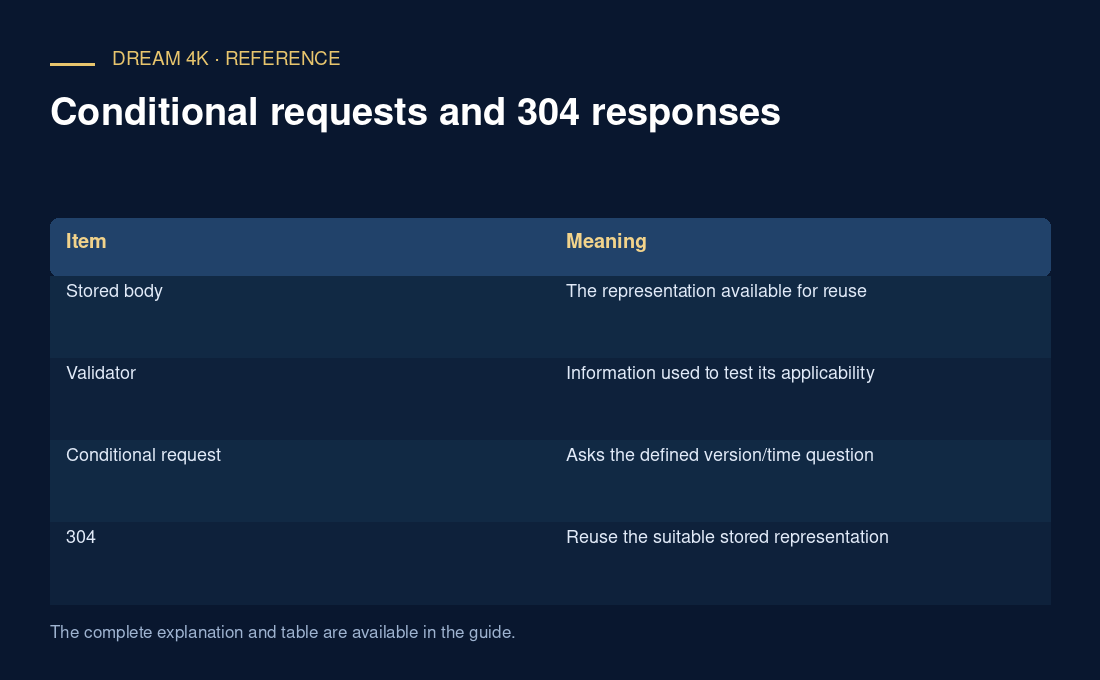
| Item | Meaning |
|---|---|
| Stored body | The representation available for reuse |
| Validator | Information used to test its applicability |
| Conditional request | Asks the defined version/time question |
| 304 | Reuse the suitable stored representation |
| 200 with new body | A transferred representation to inspect normally |
Preserve request and response together
A standalone 304 log line lacks its stored-state and conditional-header context. For diagnosis, retain the relevant validator, request condition, response metadata and playlist contents used afterward. Redact private values as appropriate.
A developer should implement validation through the platform’s correct cache mechanisms rather than treating all non-200 responses as failures. A viewer should report the player’s actual behavior and request context, because the status alone cannot establish whether the application reused content correctly.