
In this guide
Origin and request context matterEvery dependency needs the appropriate configurationCorrect the permitted server/application pathCross-Origin Resource Sharing, or CORS, is a browser mechanism governing permitted access to cross-origin responses in relevant request contexts. A web player loading media through JavaScript can encounter origin rules that differ from direct navigation to the same URL.
CORS is not an account subscription or a codec feature. A resource can exist and be reachable while the browser refuses to expose its response to a particular web application.
Origin and request context matter
An origin includes scheme, host and port. A page at one origin reading resources from another can need appropriate server response permission. Some request characteristics introduce a preflight check. Credentialed requests have additional rules; a wildcard is not a universal substitute for an explicit permitted origin.
An original hypothetical web player is hosted at player.example and fetches a playlist from media.example. Opening the playlist in a browser tab tests navigation. It does not reproduce the JavaScript fetch context or prove that the response can be read by the player page.
Every dependency needs the appropriate configuration
A multiresource presentation can involve playlists, initialization data, audio, subtitles and media on different hosts. One resource having suitable headers does not establish that all dependencies do. A redirect can also change the destination or request context.
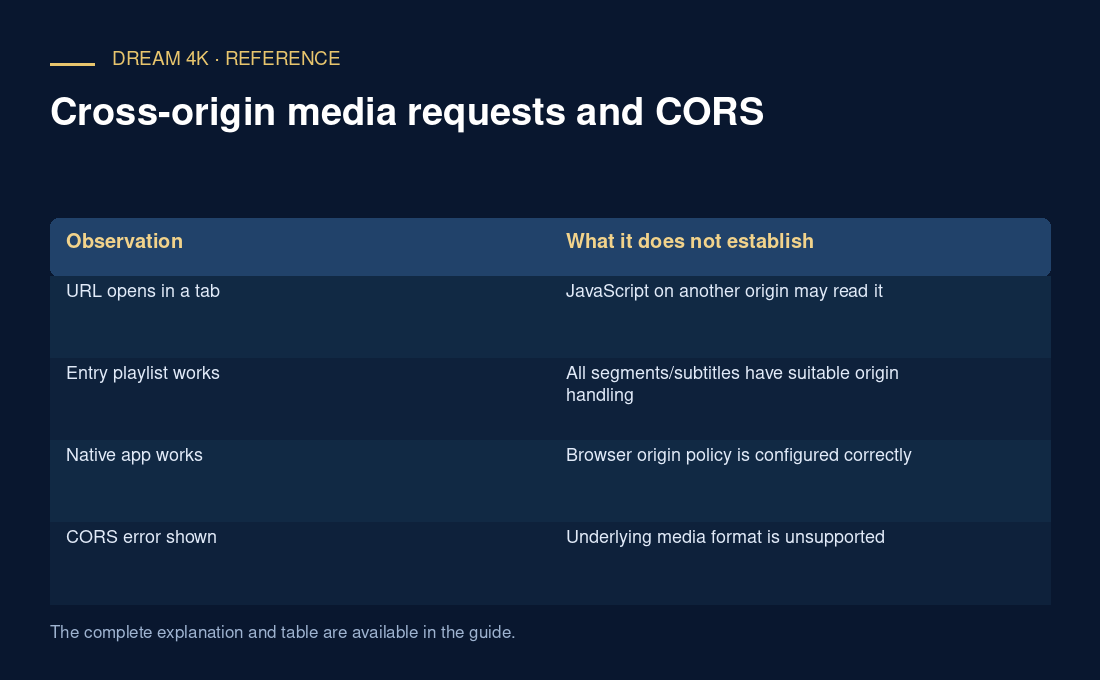
| Observation | What it does not establish |
|---|---|
| URL opens in a tab | JavaScript on another origin may read it |
| Entry playlist works | All segments/subtitles have suitable origin handling |
| Native app works | Browser origin policy is configured correctly |
| CORS error shown | Underlying media format is unsupported |
Correct the permitted server/application path
Developers should configure intended origins, methods, headers and credentials according to current documentation. Viewers should report the exact browser console message and resource role through the player/source support route.
Do not disable browser security, install unknown bypass extensions or expose credentials to a public proxy. Those actions change the trust boundary and can leak private media access. The useful fix is an authorized correctly configured delivery path, supported by a minimal redacted request/response record.