
In this guide
Find the preceding stored representationCheck what the application used afterwardReport conditions, not just the codeA network panel showing 304 and no response body can look alarming during a playback investigation. In a normal conditional exchange, the client already has the body and the server confirms that the stored representation can be reused.
The useful question is whether the player correctly uses that stored content and whether the request was actually conditional. Do not classify every non-200 status as a failed playlist fetch.
Find the preceding stored representation
Record the resource, the earlier stored body and its validator where diagnostics expose them. Then inspect the conditional request and 304 response metadata. The exchange is a relationship between the stored representation and the current check, not an isolated empty download.
In an original hypothetical session, a playlist was retrieved with status 200 and an entity tag. The next check includes a matching condition and receives 304. The client should continue using the applicable stored playlist, not replace it with an empty string and report a parse failure.
Check what the application used afterward
If playback fails, identify whether the app retained the correct body, scheduled its listed resources and handled subsequent updates. A browser-managed cache and a custom application cache can have different implementation responsibilities. Preserve the actual observed behavior rather than assuming either one is at fault.
If the live playlist remains unchanged across repeated valid checks, investigate its publishing state and freshness context separately. A correct 304 exchange does not guarantee new live segments exist, and a stale live view is not automatically caused by the validation status.
Report conditions, not just the code
A useful report contains the stored version/validator, the conditional header, response status and the body the client actually used. Add the time and playback symptom. A screenshot containing only “304” omits most of the relationship needed to assess the exchange.
Avoid forcing every request to download a full body as a permanent fix without understanding the cache implementation. For an app you develop, follow HTTP validation and cache-update rules. For a viewer, preserve a minimal redacted trace and use the player’s documented troubleshooting route. The result should distinguish a valid no-body response from an application that mishandled its stored state.
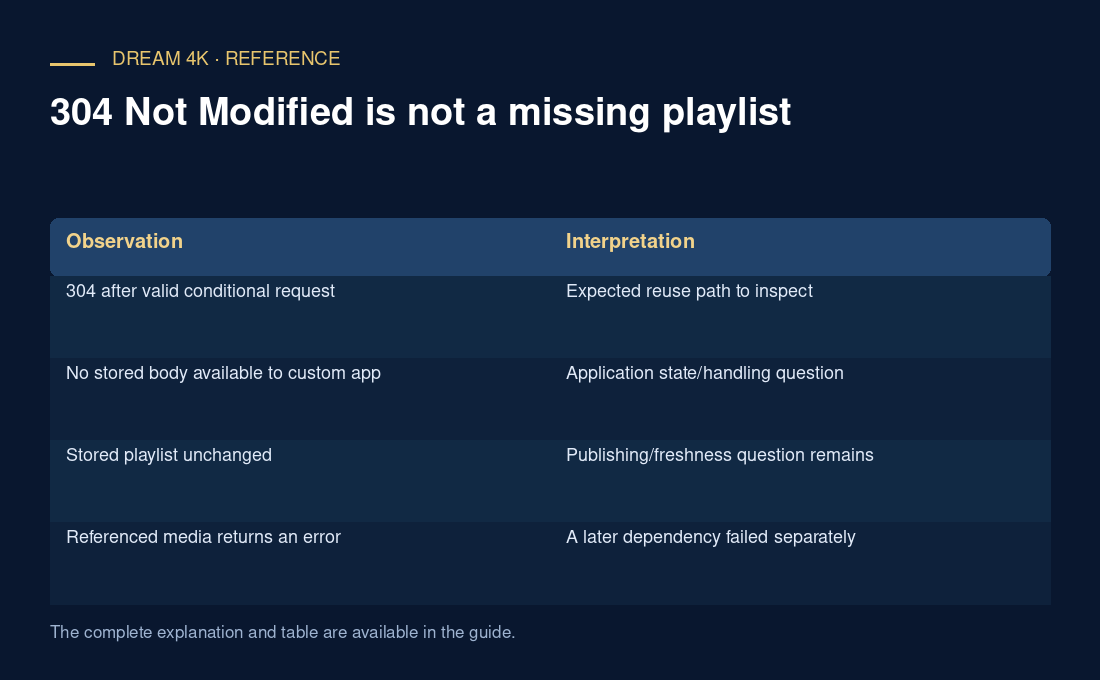
| Observation | Interpretation |
|---|---|
| 304 after valid conditional request | Expected reuse path to inspect |
| No stored body available to custom app | Application state/handling question |
| Stored playlist unchanged | Publishing/freshness question remains |
| Referenced media returns an error | A later dependency failed separately |