
In this guide
The request asks a specific future-state questionPending and failed are different observationsKeep implementation evidence scopedBlocking playlist reload lets a supported HLS client request a future playlist state. The server can hold the request until the requested new segment or part is represented, then return the updated playlist. This reduces repeated polling and discovery delay.
The word blocking describes coordinated request behavior, not a network firewall blocking the viewer. A pending request can be expected in this mode.
The request asks a specific future-state question
The client uses defined delivery directives and the server advertises relevant support. The initial playlist retrieval establishes current context; later requests can ask for newer media. The serving/cache path must handle this behavior correctly.
An original hypothetical client has seen part 4 and asks for the next expected state. The server has not published that state yet, so the request remains pending. When it becomes available, the response returns. Immediate replacement polling would not be the same mechanism.
Pending and failed are different observations
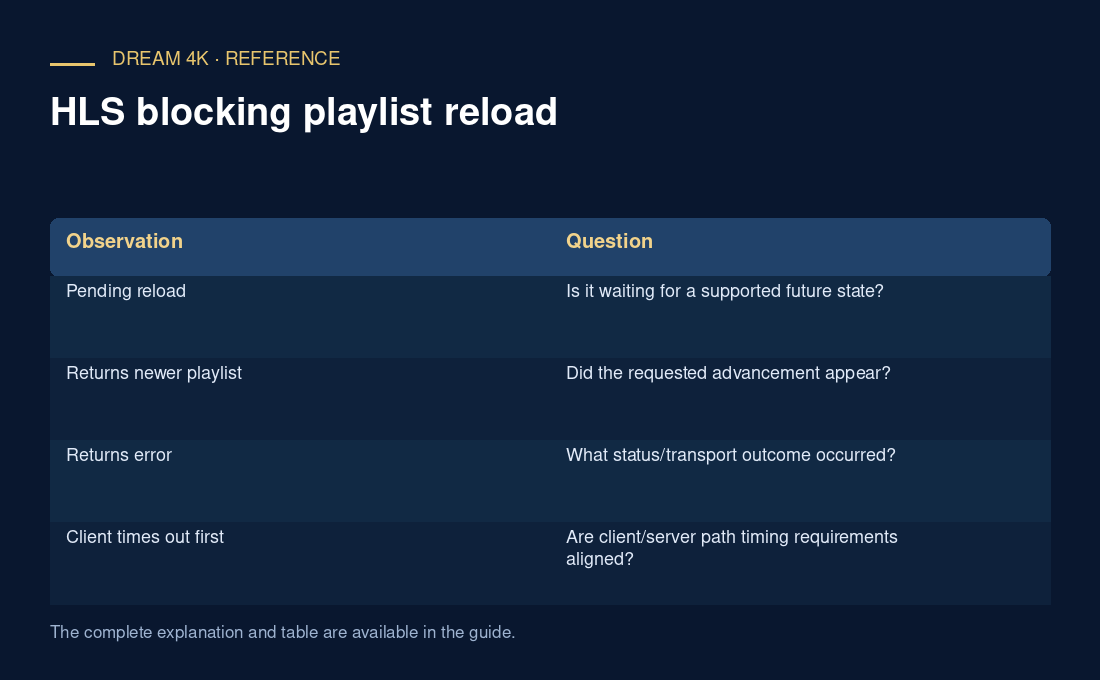
A request intentionally waiting for production differs from a transport timeout, a server error or a stale response returned immediately. Diagnose from advertised support, request role, eventual outcome and client deadlines. Do not use a universal “anything pending for one second is broken” rule.
| Observation | Question |
|---|---|
| Pending reload | Is it waiting for a supported future state? |
| Returns newer playlist | Did the requested advancement appear? |
| Returns error | What status/transport outcome occurred? |
| Client times out first | Are client/server path timing requirements aligned? |
| Repeated identical immediate bodies | Is this actually the intended blocking flow? |
Keep implementation evidence scoped
Apple’s developer guidance explains how blocking reload interacts with caches and origin request coalescing. These are backend implementation requirements, not viewer settings that can manufacture new media.
For a report, retain server-control information, the requested sequence/part context and eventual response. Redact authenticated URL values and do not hammer the endpoint with manually varied requests. Use the supported client flow so the evidence reflects actual playback behavior.