
In this guide
Establish whether blocking reload is in useObserve what happens when the wait endsAvoid replacing observation with extra pollingA network panel can show an HLS playlist request as pending while playback continues normally. With supported blocking reload, the client may be waiting for the server to publish a requested newer state.
That is different from an unanswered ordinary request or a failed connection. Preserve the request’s role and eventual outcome before applying a timeout-based explanation.
Establish whether blocking reload is in use
Record the playlist’s advertised server-control support and the request context exposed by the player. A supported client can ask for a newer sequence or part using defined directives. Do not assume that every pending playlist is blocking reload simply because the stream is live.
In an original hypothetical flow, the player has current media buffered, asks for the next part’s playlist state and waits. The server returns when that state is available. Playback need not pause during the wait because earlier media remains playable.
Observe what happens when the wait ends
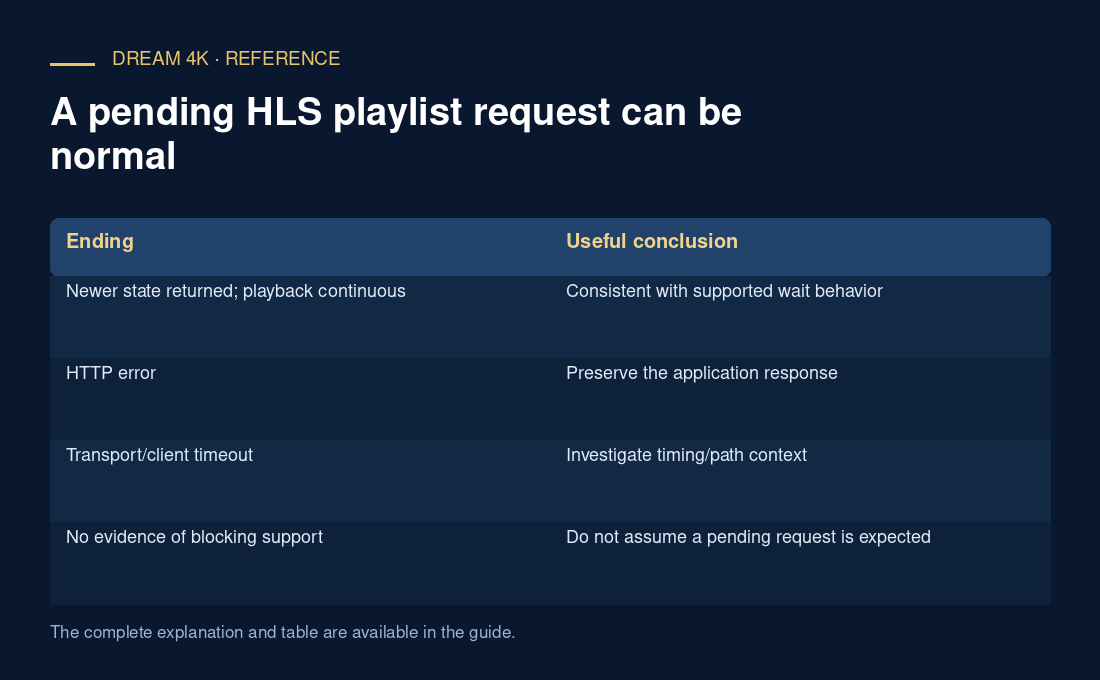
Record whether the response advances the playlist, returns an HTTP error or ends in a transport/client timeout. These outcomes answer different questions. Compare the requested future state with the returned one where diagnostics allow it, preserving the applicable sequence context.
A timeout can still be a real problem. Client, server, cache and intermediary timing behavior must align with the supported mode. The correct conclusion comes from that context, not from a universal short pending-duration threshold.
Avoid replacing observation with extra polling
Repeated manual reloads add traffic and may not reproduce the client’s coordinated request. They can also erase the distinction between a held future-state request and a fresh ordinary snapshot. Use the existing player trace or a developer-controlled standards-based test instead.
A useful report contains advertised support, requested state, pending interval, eventual status/body advancement and buffer behavior. It can identify a functioning wait, a stale response or a deadline mismatch without claiming the entire source is offline. Redact signed parameters and account data before sharing the minimal trace.
| Ending | Useful conclusion |
|---|---|
| Newer state returned; playback continuous | Consistent with supported wait behavior |
| HTTP error | Preserve the application response |
| Transport/client timeout | Investigate timing/path context |
| No evidence of blocking support | Do not assume a pending request is expected |