
In this guide
Convert length and offset explicitlyRead the response as a range responseKeep consecutive ranges in contextA byte-range HLS presentation can request the same media URL many times while selecting different portions of that object. A repeated filename is expected in this design. The useful check is whether the requested bytes correspond to the segment described by the playlist.
Use a player’s existing diagnostics or a controlled authorized test. There is no need to fetch the whole resource or expose a signed playlist URL to make the arithmetic understandable.
Convert length and offset explicitly
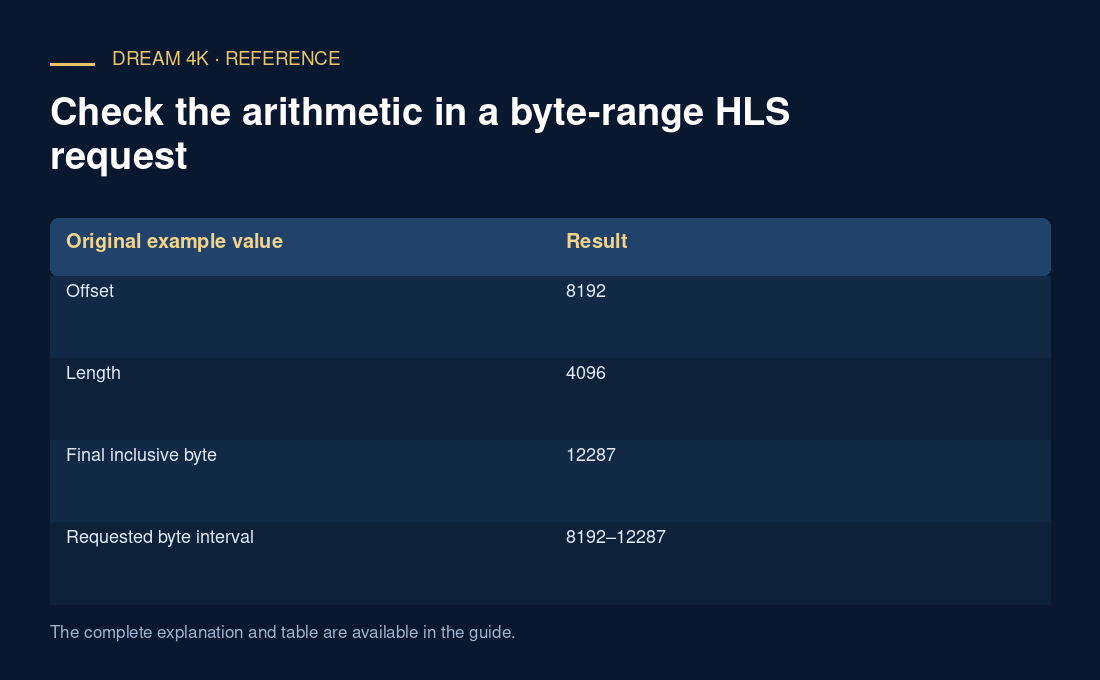
In an original hypothetical example, EXT-X-BYTERANGE identifies 4,096 bytes starting at offset 8,192. The first byte index is 8,192. The final inclusive index is 8,192 + 4,096 − 1 = 12,287. An HTTP byte request for that exact portion therefore spans bytes 8192-12287.
The subtraction of one matters: byte indices include both endpoints. Treating 12,288 as the ending index asks for an additional byte. It is also wrong to interpret 4,096 as the final byte index, because the playlist value is a length in this example.
Read the response as a range response
Compare the request’s Range value with the response status and Content-Range metadata. A 206 response is normal for a satisfiable partial request. A 200 response may mean that the server returned a complete representation rather than the requested slice; whether a particular player can handle that depends on its implementation and context.
A 416 response calls for checking the requested range against the actual representation and the server’s reported information. The playlist could be stale, the object could have changed, or the requested offset could be wrong. The code identifies a range problem, not which component introduced it.
Keep consecutive ranges in context
When HLS omits an explicit offset, the protocol defines how continuation works. Preserve the preceding BYTERANGE and resource context instead of interpreting the isolated line. Likewise, include whether the object URL changed between requests, because a continuation cannot be understood from a single number alone.
A precise report contains the playlist’s length and offset, the calculated inclusive range, the observed request and response range, and the time of the failure. If one range succeeds and the next fails, that adjacency is useful. Avoid claiming packet loss merely because a request returned partial content; “partial” describes an intentional HTTP representation range.
| Original example value | Result |
|---|---|
| Offset | 8192 |
| Length | 4096 |
| Final inclusive byte | 12287 |
| Requested byte interval | 8192–12287 |
| Number of included bytes | 12287 − 8192 + 1 = 4096 |