
In this guide
Bitrate choice and language choice are different decisionsThe selected representation defines an actual workloadCompare the actual choicesIn DASH, a Representation describes an encoded media choice and its associated resources. An AdaptationSet groups related representations with shared context. The structure helps a client select tracks and, where appropriate, switch between alternatives.
Grouping is not merely a folder of filenames. Language, role, media type and compatibility relationships matter to the meaning of the choices.
Bitrate choice and language choice are different decisions
Several video representations can provide the same content at different encoded operating points. Audio groups can distinguish languages or roles. A player should not treat every representation in a presentation as interchangeable simply because they have similar bit rates.
An original hypothetical MPD has a video AdaptationSet with v-low and v-high, plus separate English and Spanish audio choices. Switching between v-low and v-high concerns video adaptation. Selecting Spanish concerns listening preference. Lowering video bit rate need not imply a language change.
The selected representation defines an actual workload
Its dimensions, frame rate, codecs, bandwidth information and initialization/media addressing help describe what the player will process. Shared group metadata and inherited addressing context can also apply, so an isolated Representation line can be incomplete.
A familiar codec family in one representation does not establish support for every other configuration in the same manifest.
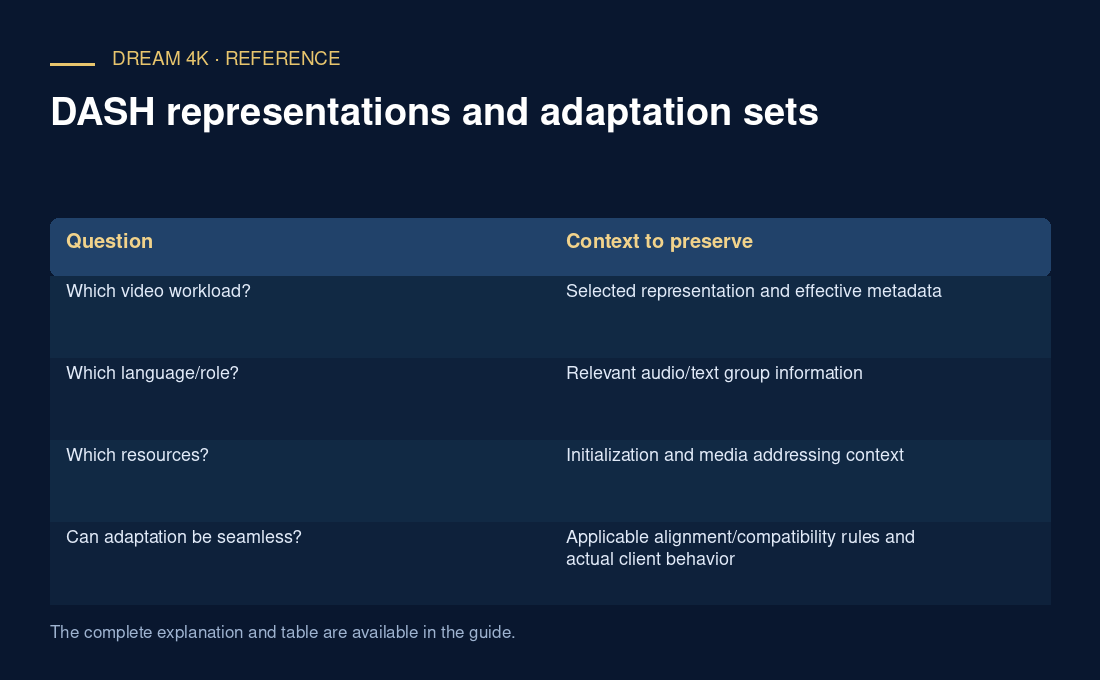
| Question | Context to preserve |
|---|---|
| Which video workload? | Selected representation and effective metadata |
| Which language/role? | Relevant audio/text group information |
| Which resources? | Initialization and media addressing context |
| Can adaptation be seamless? | Applicable alignment/compatibility rules and actual client behavior |
Compare the actual choices
For diagnosis, retain the selected representation identifier and its group. If an alternate works, record which parameters and track choices changed. A comparison that changes codec, frame rate and language simultaneously cannot isolate one cause.
The DASH-IF timing document provides a constrained interoperability model, including representation timing and grouping context. Do not convert its scoped requirements into a promise that every generic DASH player supports every optional source configuration.