
In this guide
Map each interval onto the presentationA transition can change more than one dependencyReport both sides of the boundaryA DASH Period describes an interval within an MPD presentation. It provides context for its adaptation sets and representations. Moving into another Period can change timing relationships, track choices or media configuration under the presentation’s rules.
A Period boundary is not automatically an error or a programme boundary. It is a structural relationship that should be interpreted with the surrounding manifest and media.
Map each interval onto the presentation
Period start and duration information establish timeline relationships under the applicable model. The DASH-IF restricted timing guidance emphasizes explicit alignment and continuity constraints intended to improve interoperability. Its requirements are scoped guidance, not evidence that an arbitrary manifest conforms.
An original hypothetical presentation has one Period ending at sixty seconds and another beginning there. A player must map the next Period’s sample timeline correctly; raw media timestamp values need not look like continuous wall-clock seconds without applying their timescale and offset.
A transition can change more than one dependency
The following Period can offer different representations, audio roles, initialization data or addressing context. A failure precisely there can therefore involve selection, timing, resources or decoding. Preserve what changed rather than treating the boundary itself as proof of a network fault.
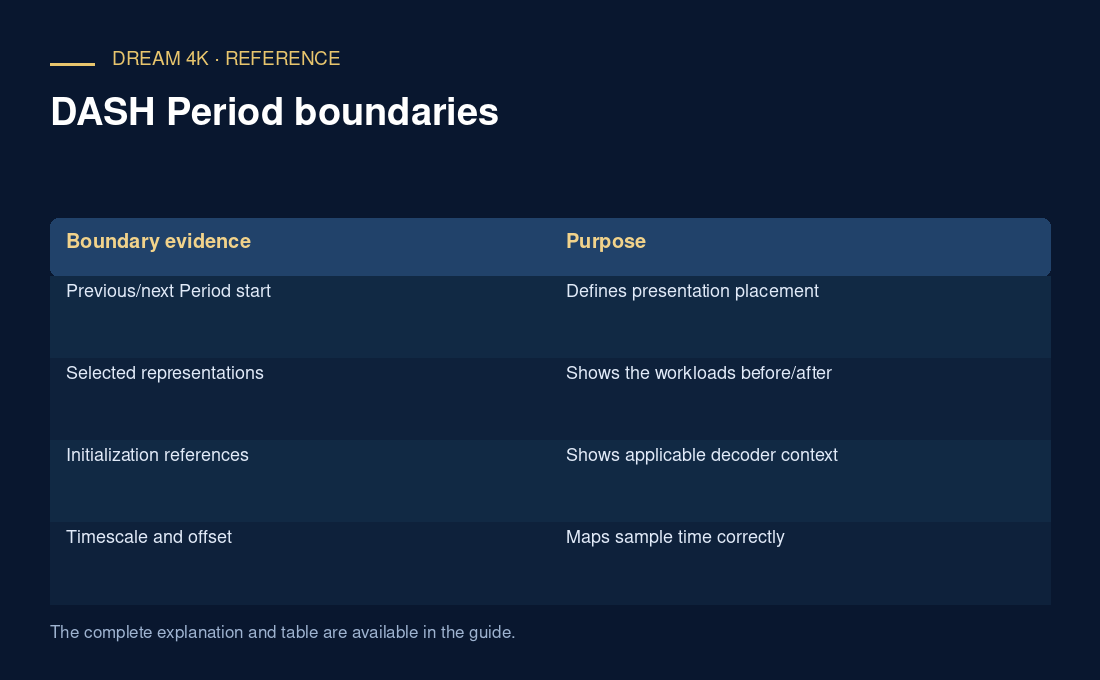
| Boundary evidence | Purpose |
|---|---|
| Previous/next Period start | Defines presentation placement |
| Selected representations | Shows the workloads before/after |
| Initialization references | Shows applicable decoder context |
| Timescale and offset | Maps sample time correctly |
| Request outcomes | Separates delivery from later parsing/decoding |
Report both sides of the boundary
A repeatable failure is more useful when it includes the last successful resource and first failing dependency. Audio continuing while video stops adds another dimension. A live MPD snapshot can change, so record retrieval and observation times.
Do not splice Periods or rewrite timeline values in a provider manifest as a generic repair. Authors should validate their presentation; viewers should preserve the original context and use supported alternatives or the documented support route. A boundary observation can narrow the case without naming an unproven root cause.