
In this guide
Do not confuse band names with other numbersWider is not automatically better in every environmentCompare the affected clientA Wi-Fi band, a channel and channel width describe different parts of a wireless configuration. Common consumer systems can offer 2.4 GHz, 5 GHz and, on supported equipment and in permitted regions, 6 GHz operation. A device can use only the modes its hardware and current configuration support.
The name of a band is not an application-throughput measurement. A successful wireless association still shares the wider home and internet delivery path.
Do not confuse band names with other numbers
Five-gigahertz Wi-Fi is not the same label as fifth-generation cellular service. Channel width is commonly expressed in megahertz and concerns the occupied channel span, not the broadband package rate. A multiband router does not guarantee that an older client can use every offered band.
An original hypothetical router offers several bands, but a television associates only with one supported mode. A phone using another band beside the router is not a matched test of the television’s actual link.
Wider is not automatically better in every environment
Wider channels can offer more capacity under suitable conditions while changing interference and compatibility considerations. Apple’s router guidance distinguishes its 2.4 GHz width recommendation from its 5/6 GHz guidance. Apply the current manufacturer instructions for the actual network rather than one universal setting.
Record the existing configuration before a reversible comparison. Security, firmware and consistent network setup remain part of the supported path.
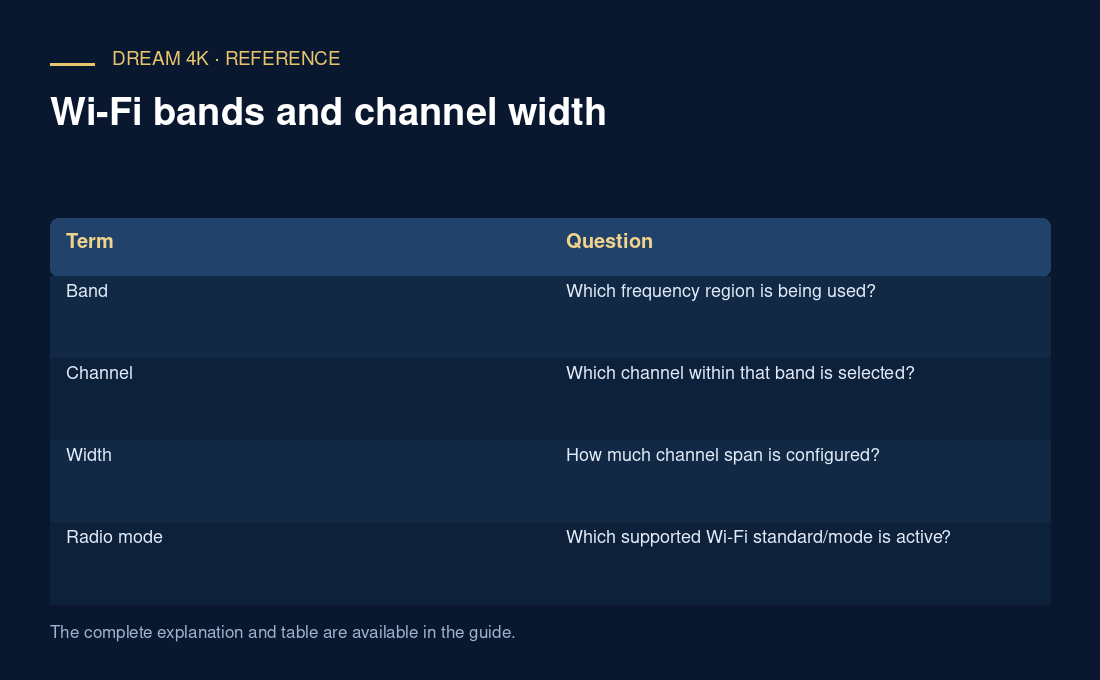
| Term | Question |
|---|---|
| Band | Which frequency region is being used? |
| Channel | Which channel within that band is selected? |
| Width | How much channel span is configured? |
| Radio mode | Which supported Wi-Fi standard/mode is active? |
| Application throughput | How quickly did useful media actually arrive? |
Compare the affected client
Use the router/client information available for that device and time. A different device’s signal bars or speed test cannot establish its conditions. If a documented band or placement comparison changes playback, preserve the exact association and media timing.
Avoid fixed range, room-count or speed guarantees based only on a band label. The local environment, equipment and traffic need observation.