
In this guide
Identify both local linksMove the point for an upstream comparisonVerify the actual media consequenceFull wireless bars at a television describe its immediate association, not necessarily the mesh point’s upstream connection. If that point has a weak path to the router, the client can be close to a bottleneck rather than close to a good internet path.
Use the mesh system’s documented inter-node test and verify which point the affected device actually uses. Do not infer association solely from physical proximity.
Identify both local links
Record the client-to-point association and the point-to-router or upstream-node status. Some systems expose this in their administration app. Google’s mesh test specifically measures the connection between the primary device and additional points; equivalent diagnostics vary by manufacturer.
In an original hypothetical home, the television is next to a point behind a thick obstruction from the main router. A phone beside the main router performs well. That comparison is consistent with a local mesh-path question, but it does not isolate a specific wall, channel or device fault without further evidence.
Move the point for an upstream comparison
Follow current placement guidance and preserve the original location. A point often needs a useful connection to the rest of the mesh rather than placement at the most distant weak spot. After a supported move, rerun the mesh test and confirm the television’s association.
Avoid adding more points as an automatic cure before checking the existing topology. A different arrangement can change roaming and shared wireless behavior. Supported wired backhaul can be another design option, but it requires exact-system guidance rather than a universal cabling assumption.
Verify the actual media consequence
Compare the same permitted item close in time, recording request timing and buffer behavior if available. A better mesh rating with unchanged playback leaves other explanations open. A stable wired comparison can add evidence but does not certify every upstream service.
A useful report includes the client’s point, inter-node test result, placement change and before/after media observation. It should not say “Wi-Fi is perfect” because the bars are full or promise that a mesh product guarantees uninterrupted 4K. The result is a controlled local-path finding, with source and decoder layers still assessed separately.
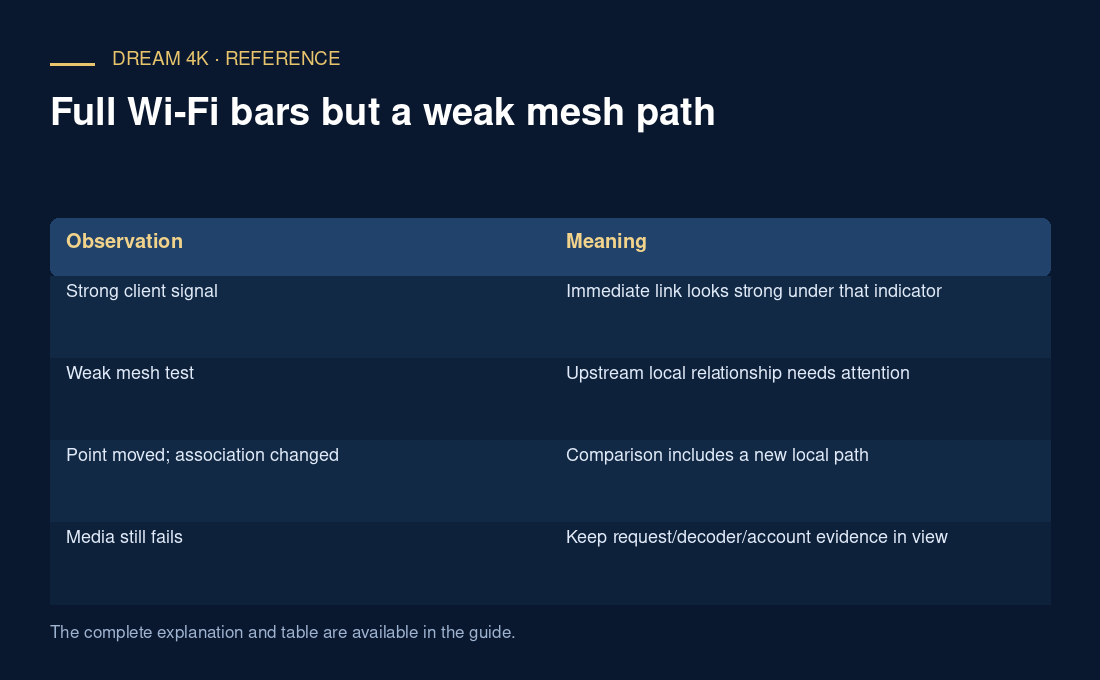
| Observation | Meaning |
|---|---|
| Strong client signal | Immediate link looks strong under that indicator |
| Weak mesh test | Upstream local relationship needs attention |
| Point moved; association changed | Comparison includes a new local path |
| Media still fails | Keep request/decoder/account evidence in view |