
In this guide
Size-dependent failures need specific evidenceFile size is not packet sizeUse documented diagnosis and reversible settingsThe path maximum transmission unit, or path MTU, concerns the largest packet size that can traverse a network path without needing fragmentation under the relevant mechanism. Different links and encapsulations can impose different limits along the route.
Applications and transports use discovery and packetization strategies to operate within effective path limits. A small diagnostic exchange succeeding does not, by itself, establish that every larger packet pattern works correctly.
Size-dependent failures need specific evidence
A path-size problem can appear when particular packet sizes are not delivered and the sender does not adapt appropriately. RFC 8899 describes datagram packetization-layer discovery and black-hole detection/recovery mechanisms. This is a protocol-level issue, not a reason to assign one universal manual MTU to every home router.
An original hypothetical path carries small exchanges but consistently fails larger datagrams under a controlled method. That pattern justifies investigating packet size and path behavior. A large video file failing without packet evidence is less specific, because the file consists of many packets and can fail for unrelated reasons.
File size is not packet size
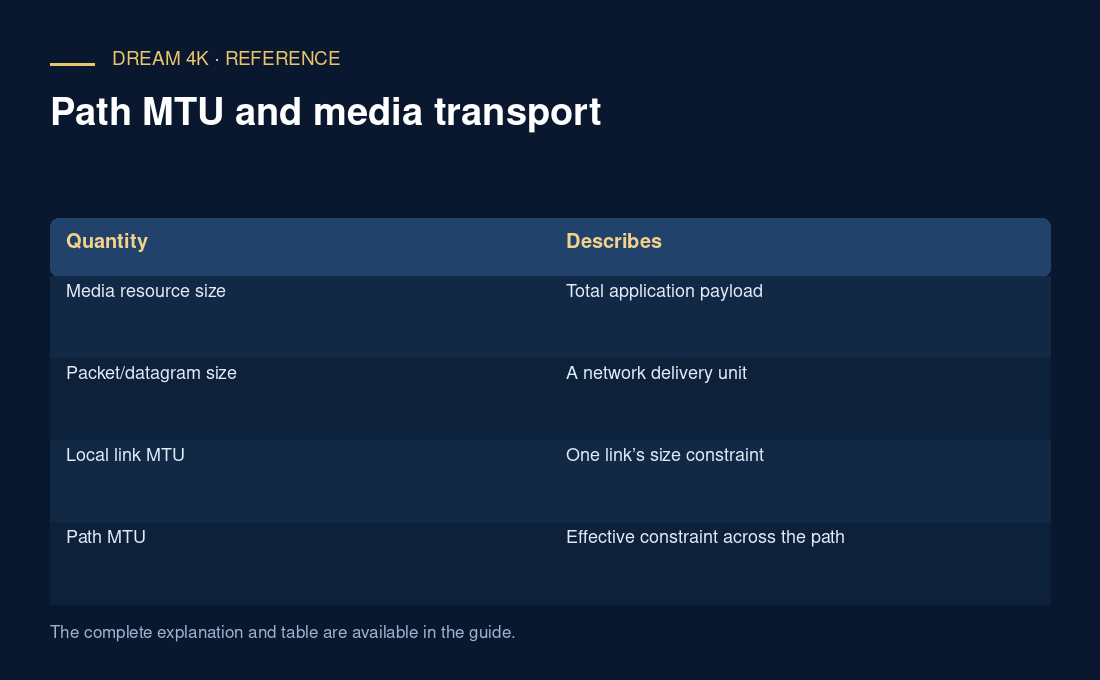
A ten-megabyte media resource does not require a ten-megabyte IP packet. Transports divide data into appropriate units. Conversely, a short application message can be carried in an encapsulated path whose effective packet budget differs from the local link’s advertised value.
| Quantity | Describes |
|---|---|
| Media resource size | Total application payload |
| Packet/datagram size | A network delivery unit |
| Local link MTU | One link’s size constraint |
| Path MTU | Effective constraint across the path |
| Encapsulation overhead | Additional bytes reducing usable budget in context |
Use documented diagnosis and reversible settings
Record the affected protocol, network, error and repeatable size-dependent behavior. Network administrators and implementers can use appropriate standards-based tests. Viewers should follow current device/router guidance rather than trying random values or disabling protective network functions.
A controlled alternate-network comparison can narrow the path context, but it does not alone prove MTU. Preserve the distinction between a plausible size-sensitive mechanism and an established cause.