
In this guide
The sample defines the claimRecovery changes the visible symptomReport correlation before causationPacket loss describes packets that do not arrive under a stated measurement definition. A useful result identifies the source, destination, packet type, timing and observation method. A percentage without that context cannot describe every application using the connection.
Different transports react differently to missing packets. TCP and QUIC can recover reliable data, potentially at a timing cost. An application using raw datagrams may apply its own recovery, tolerate gaps or fail according to its design.
The sample defines the claim
Sending one hundred probes and missing two responses gives a two-percent missing-response result for that test sample. It does not prove that two percent of the video payload was lost. Probe traffic can follow different treatment, and a round-trip result combines outward and return behavior.
An original hypothetical comparison shows lost probes to a router that rate-limits replies while media beyond it continues normally. That is a reason to avoid treating an intermediate hop’s reply rate as a direct measurement of forwarded media loss.
Recovery changes the visible symptom
A reliable transport can retransmit missing data so the application receives correct bytes later. The visible effect may be lower throughput or a consumed buffer rather than corrupted pictures. Conversely, missing media in a datagram-based design can have a different result depending on packetization and recovery mechanisms.
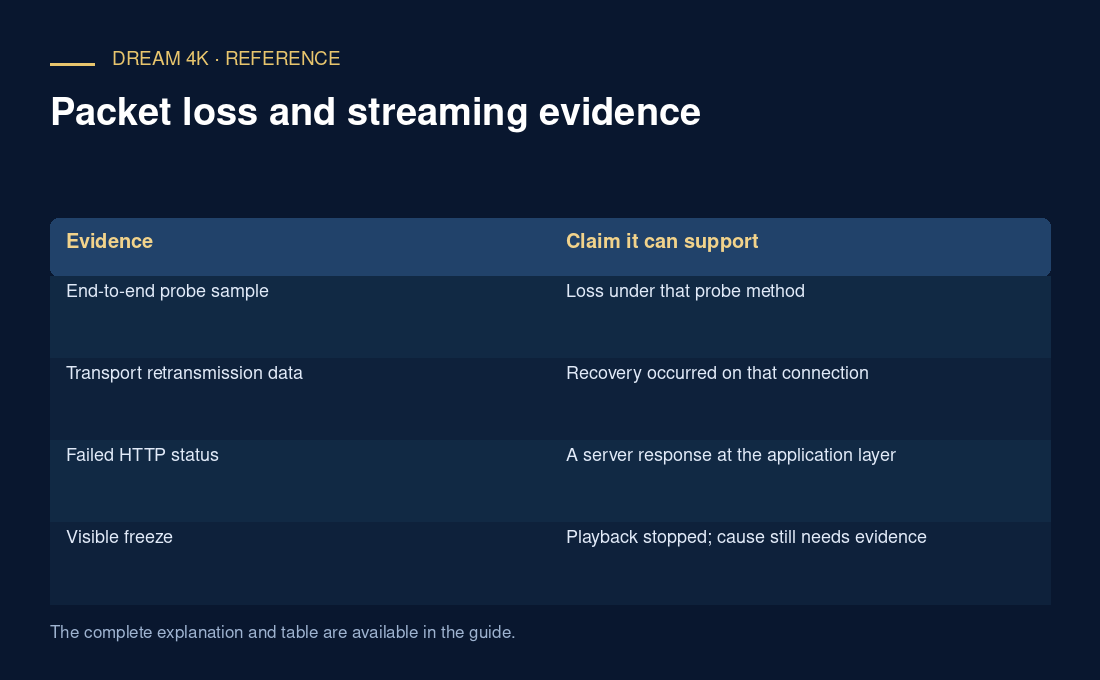
A freeze alone is not a packet-loss counter. A 404 response is an explicit application-layer resource response, not evidence that an IP packet vanished.
| Evidence | Claim it can support |
|---|---|
| End-to-end probe sample | Loss under that probe method |
| Transport retransmission data | Recovery occurred on that connection |
| Failed HTTP status | A server response at the application layer |
| Visible freeze | Playback stopped; cause still needs evidence |
Report correlation before causation
If retransmissions or end-to-end loss rise during the same interval as late segment delivery, preserve both observations with timestamps. A matched interval strengthens the case for further transport investigation. It still may not identify where the loss occurred.
Avoid arbitrary global loss thresholds for all video. The relevant consequences depend on traffic pattern, recovery, media deadlines and available buffer. Use precise observed facts rather than promising that zero ping loss guarantees uninterrupted playback.