
In this guide
Connection direction mattersDouble NAT is a topology descriptionUse actual reachability evidenceNetwork Address Translation changes address information as traffic crosses a translating device. Traditional IPv4 NAT commonly allows private-network clients to communicate through an external address using maintained translation state.
That function is distinct from Wi-Fi association, DHCP configuration, DNS resolution and media decoding. A streaming failure does not automatically establish a NAT problem or a need for inbound port forwarding.
Connection direction matters
An ordinary client retrieving HTTP media initiates requests toward a serving system. Unsolicited inbound access to a device is another requirement and needs its own application documentation. A generic suggestion to open ports should not be applied merely because outbound playback paused.
An original hypothetical player requests an HTTPS playlist from inside a home network. That is not the same design as hosting a media server for outside clients. The two tasks can have different reachability requirements.
Double NAT is a topology description
If more than one device translates the path, the setup can be described as double NAT. Some applications or network functions can be affected, but the label alone does not prove why a particular HTTP segment failed. Apple’s home-router guidance treats NAT configuration as part of a coherent network design.
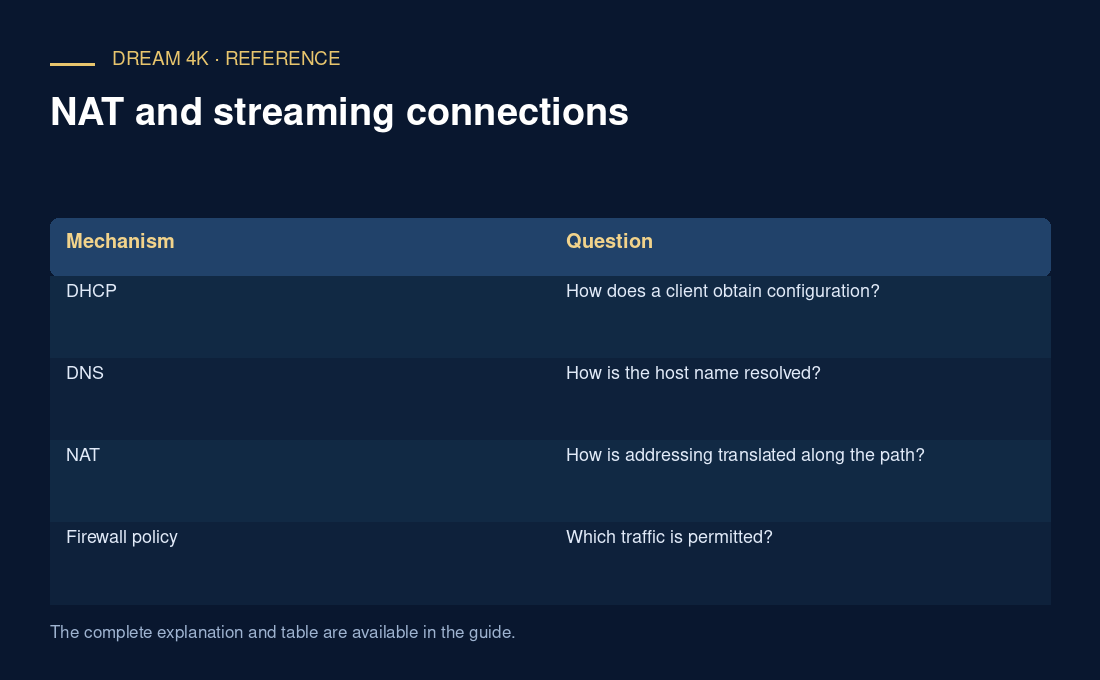
| Mechanism | Question |
|---|---|
| DHCP | How does a client obtain configuration? |
| DNS | How is the host name resolved? |
| NAT | How is addressing translated along the path? |
| Firewall policy | Which traffic is permitted? |
| HTTP response | What did the application endpoint return? |
Use actual reachability evidence
Record the topology only as far as known, the application’s documented requirements and the exact failed stage. A 403 response proves the request reached an application endpoint that refused it; adding inbound mappings does not explain that response.
Do not expose a streaming device or disable protective rules to test an unsupported theory. If a documented application genuinely needs inbound access, the network administrator should configure the specific supported path. For ordinary playback, start with observed outbound request failures and preserve the distinction between a topology fact and an established cause.