
In this guide
Availability and presentation are separate positionsTiming cushion has a practical roleReport the position and referenceThe live edge is an operational idea around the newest available media in a live presentation. A client’s playback position can sit behind that point, leaving media available to absorb some delivery variation. Different protocols and players define their specific timing controls and boundaries.
Distance from the available edge is not the complete physical event-to-screen delay. Media can already have accumulated delay before it is published.
Availability and presentation are separate positions
An original hypothetical source has published media through presentation time 100 seconds while a client plays at 94. The six-second difference describes that simplified timeline relationship. It does not include an earlier production delay or prove that the physical event occurred six seconds ago.
A client at 99 seconds has less already-published media ahead in this example. Whether that is stable depends on how the next media is produced and delivered, not only on the desired position.
Timing cushion has a practical role
A deeper position can absorb some late arrival while adding delay relative to newest available media. Moving closer can reduce that component of delay while exposing more deadlines to production and network variation. This is a tradeoff to observe, not a claim that one universal buffer value is optimal.
Low-latency mechanisms change publication and discovery behavior, but supported client/server timing requirements still apply.
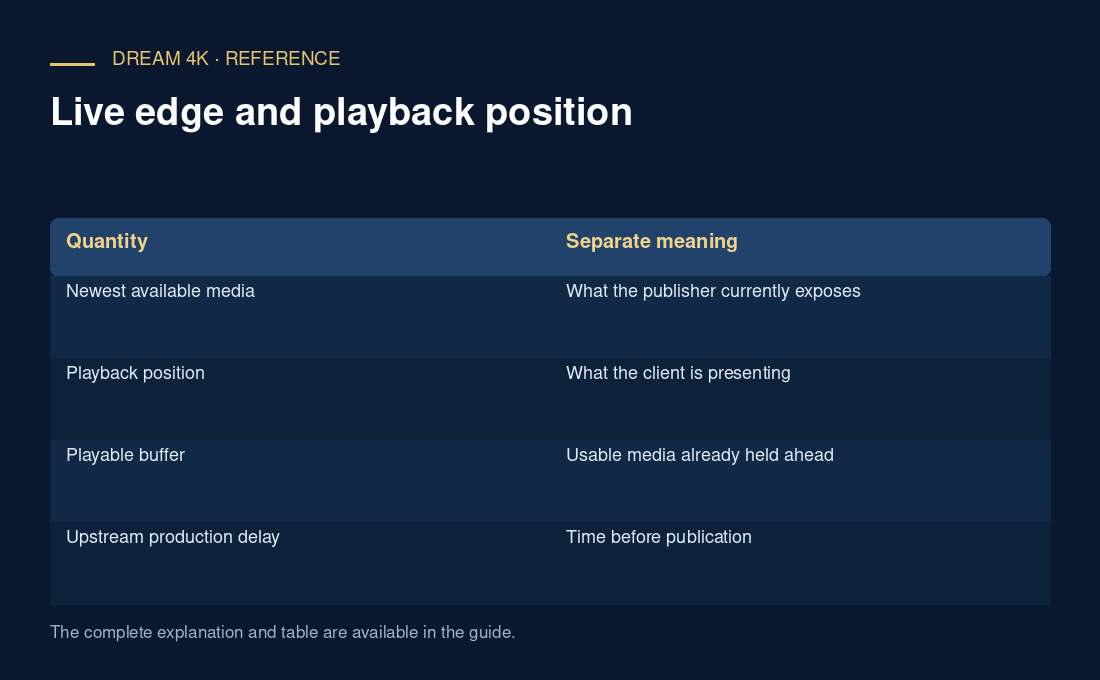
| Quantity | Separate meaning |
|---|---|
| Newest available media | What the publisher currently exposes |
| Playback position | What the client is presenting |
| Playable buffer | Usable media already held ahead |
| Upstream production delay | Time before publication |
| End-to-end delay | A reference-based observation across the whole path |
Report the position and reference
Keep the selected mode, observed position, available-media context and any reference clock with a latency observation. A programme-date-time label may describe a source-chosen mapping rather than camera capture.
Use documented controls and do not remove safety margins by rewriting provider playlists. A useful finding states whether moving a supported position changed delay and continuity under the observed conditions, with no guaranteed number inferred from a setting.