
In this guide
Read the declared constraint correctlyThree quantities that often get conflatedAn original interpretation exampleEXT-X-TARGETDURATION declares a media playlist’s target duration in integer seconds. It constrains segment durations under the HLS protocol’s rounding rule. It does not mean that every segment lasts exactly that long, and it does not describe a complete viewer-to-live delay.
This value helps a client operate the playlist correctly, but interpreting it requires looking at the actual EXTINF durations and the type of presentation. A playlist containing six-second segments can still be played well behind its newest available media.
Read the declared constraint correctly
RFC 8216 requires each media segment’s EXTINF duration, rounded to the nearest integer, to be no greater than the target duration. This is more specific than simply comparing every decimal duration to the integer as a strict upper bound. Authors should validate the applicable specification and current platform requirements rather than rely on a casually rounded display.
For viewers, the main practical lesson is to record the declaration and the actual segment durations separately. An application’s displayed buffer setting is a third quantity with a different role.
Three quantities that often get conflated
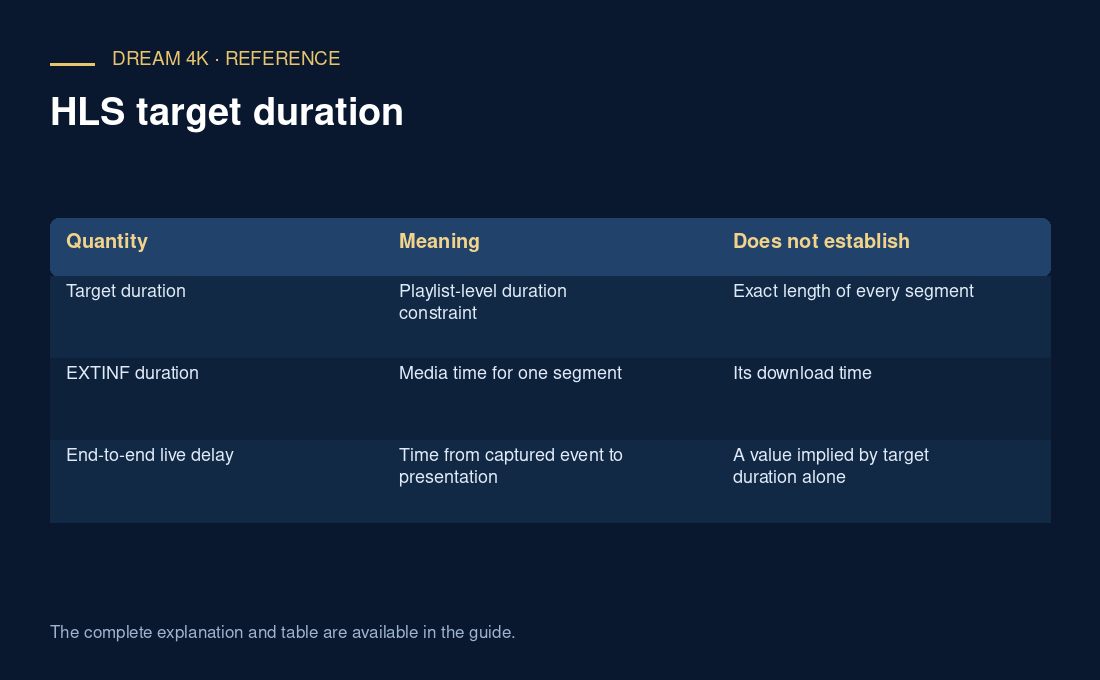
| Quantity | Meaning | Does not establish |
|---|---|---|
| Target duration | Playlist-level duration constraint | Exact length of every segment |
| EXTINF duration | Media time for one segment | Its download time |
| End-to-end live delay | Time from captured event to presentation | A value implied by target duration alone |
An original interpretation example
Suppose a hypothetical playlist declares a target of six seconds and lists durations around four to six seconds. That is not evidence that playback is six seconds behind a broadcast. The client may start several segments from the newest edge; encoding and publication add their own delay; a display can add further processing.
A malformed duration declaration can cause interoperability problems, but changing the number in a local copy does not change the underlying media, timestamps or server publishing behavior. Preserve the original response when reporting a suspected authoring issue. For a meaningful report, include the tag, the relevant EXTINF values and the resource order, with access secrets removed.
For low-latency HLS, additional timing declarations apply. Do not use the traditional segment target as a substitute for the part target or hold-back values. Those mechanisms need their own interpretation and compatible client support.