
In this guide
Interpret the timestamp and its scopeKeep three clocks separateUse it as evidence with stated assumptionsEXT-X-PROGRAM-DATE-TIME associates the first sample of the following HLS media segment with an absolute date/time. It provides an informative mapping between media timing and a wall-clock label. The source chooses the mapping under the protocol’s consistency rules.
The label is not automatically the physical camera-capture time. A date can describe production or another source-defined time unrelated to the viewer’s current playback clock.
Interpret the timestamp and its scope
The tag applies to the next segment and can include timezone and fractional seconds. Media timestamps and durations then supply context for other points in the timeline. Preserve discontinuity context when interpreting mappings across changes.
An original hypothetical segment begins with a programme-date-time label of 2026-11-03T15:00:00Z. A point two seconds into that mapped media interval corresponds to 15:00:02Z under a continuous mapping. This says where the media is labelled, not when a viewer’s request completed.
Keep three clocks separate
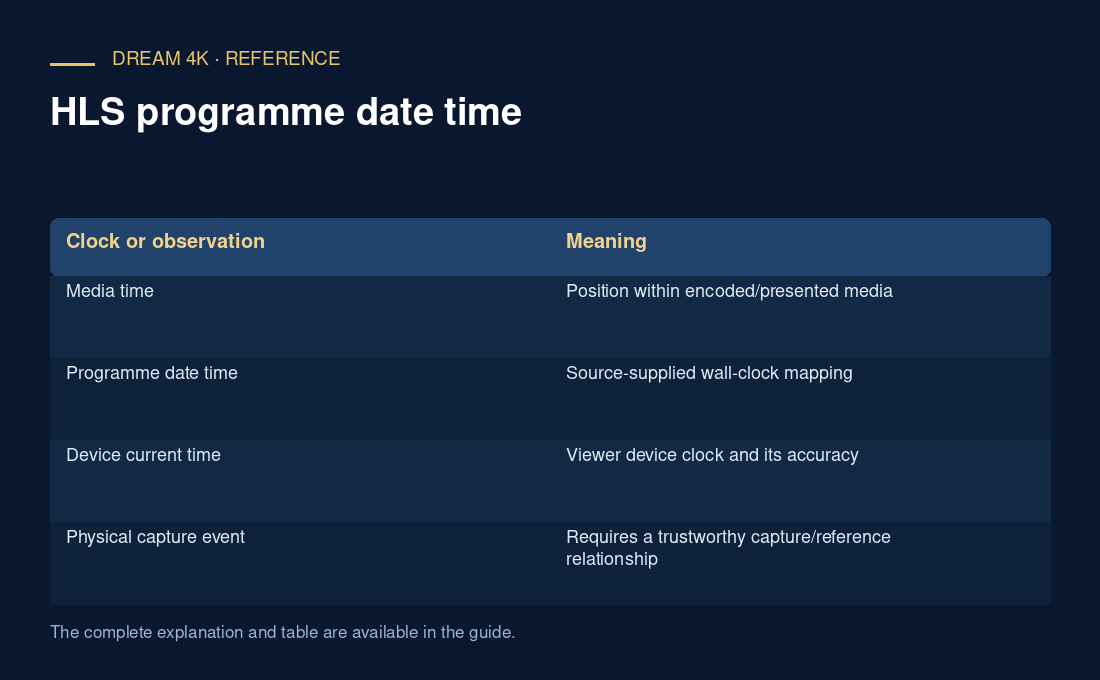
| Clock or observation | Meaning |
|---|---|
| Media time | Position within encoded/presented media |
| Programme date time | Source-supplied wall-clock mapping |
| Device current time | Viewer device clock and its accuracy |
| Physical capture event | Requires a trustworthy capture/reference relationship |
Use it as evidence with stated assumptions
A difference between device time and a mapped playback point can be useful if the device clock is accurate and the source mapping’s meaning is known. It still may include a source-side offset. Do not call it glass-to-glass latency without establishing the capture relationship.
For a report, include the original tag, segment context, playback position, observation time and timezone. A sequence number is not a substitute for this mapping, and an EPG timestamp describes another metadata function. Correct timezone conversion should preserve the represented instant rather than shift the media itself.
When mapping is ambiguous or changes unexpectedly, preserve the original playlist around the boundary and let the publisher validate its timeline. Editing the date locally does not change capture or delivery delay.