
In this guide
Map one media position explicitlyPreserve timezone and timeline contextReport assumptions alongside the resultA playlist wall-clock label can look like a ready-made live-latency measurement. It becomes meaningful only when you know what the source mapped and how accurately your observation clock represents current time.
HLS explicitly treats programme-date-time as an informative mapping, and playlist dates can refer to production or other times. Do not assume every label is the moment a camera exposed the frame.
Map one media position explicitly
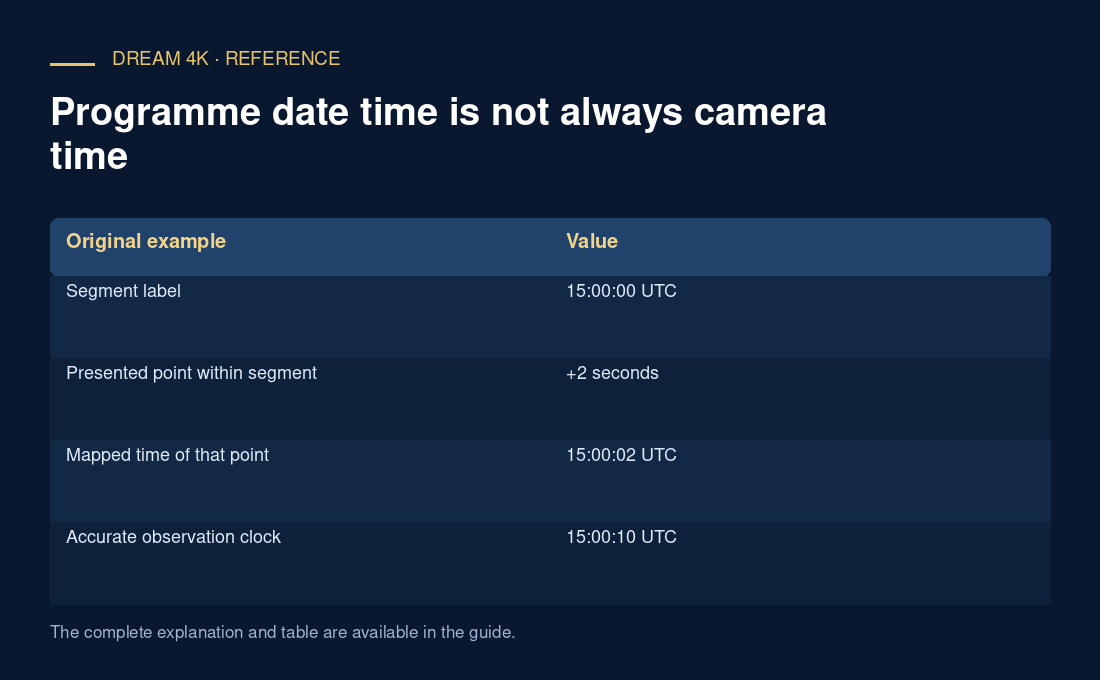
In an original hypothetical playlist, a segment’s first sample is labelled 15:00:00 UTC. A continuous point two seconds later maps to 15:00:02 UTC. If an accurate device clock reads 15:00:10 UTC when that point is presented, the difference is eight seconds relative to the label.
The correct statement is “eight seconds behind the source’s mapped time at this observation.” Calling it camera-to-screen delay requires separate evidence that the source label corresponds to the physical capture event and that the measurement clocks are trustworthy.
Preserve timezone and timeline context
Keep the original offset or UTC marker, fractional precision and applicable segment/discontinuity information. Convert the timestamp as an instant rather than adding a local offset twice. A media sequence number cannot supply the same wall-clock meaning.
A programme clock graphic may also originate at another production stage. Comparing it with a playlist label can reveal a difference but does not automatically identify which clock is correct or where an offset was introduced.
Report assumptions alongside the result
Record the source mapping, the exact media position, device observation time, timezone and clock uncertainty. State whether the source’s label meaning is documented or merely assumed. If two clients are compared, note their different selected positions and display paths.
A useful report can show an unexpected mapping jump or a repeatable label-relative difference. It should not promise a provider latency number or diagnose network delay from the label alone. Source processing, publication, playback position and display all remain separate contributors unless the measurement method establishes them.
| Original example | Value |
|---|---|
| Segment label | 15:00:00 UTC |
| Presented point within segment | +2 seconds |
| Mapped time of that point | 15:00:02 UTC |
| Accurate observation clock | 15:00:10 UTC |
| Label-relative difference | 8 seconds; capture relationship unconfirmed |