
In this guide
Separate source precision from output precisionCheck processing and compression as separate variablesMake a bounded observationVisible steps in a sky or dark gradient can originate before the signal reaches the display. Source quantization, compression and processing can all affect the result. Selecting a ten-bit output mode adds no guarantee that missing source gradations will reappear.
Use a known permitted test source and a repeatable scene. A random compressed screenshot can introduce its own banding and is not a reliable substitute for the original video path.
Separate source precision from output precision
Record the source bit depth if known, the selected codec configuration and the device output format. Eight-bit and ten-bit are sample-precision descriptions, while bit rate is data per second. A high bit-rate number does not itself establish ten-bit precision.
In an original hypothetical pipeline, eight-bit material is decoded and sent through a ten-bit output. The output has more representable code values, but the source’s quantization steps were already present. Merely storing or transmitting those steps at greater precision does not recreate the original continuous gradient.
Check processing and compression as separate variables
Compare the same scene with stable picture settings. Noise reduction, contrast processing and other transformations can change gradient appearance. Compression can also remove subtle variation. If several controls change together, report that the test does not isolate bit depth.
Dithering can alter the visibility of steps by distributing error, but it is not evidence that missing source information was recovered. A display’s marketing colour count similarly does not prove the entire streaming chain preserved that precision.
Make a bounded observation
If a known high-quality source and another compressed source behave differently through the same path, preserve that contrast. If every source shows the same pattern, investigate common processing/output/display stages using exact-model documentation. Do not assign a panel defect from one uncertain stream.
A useful report includes scene position, source depth if confirmed, codec, output format, display mode and the specific banding pattern. State which fields remain unknown. This can guide a source, processing or display investigation without promising that a ten-bit toggle, HDR mode or higher subscription resolution will solve every gradient problem.
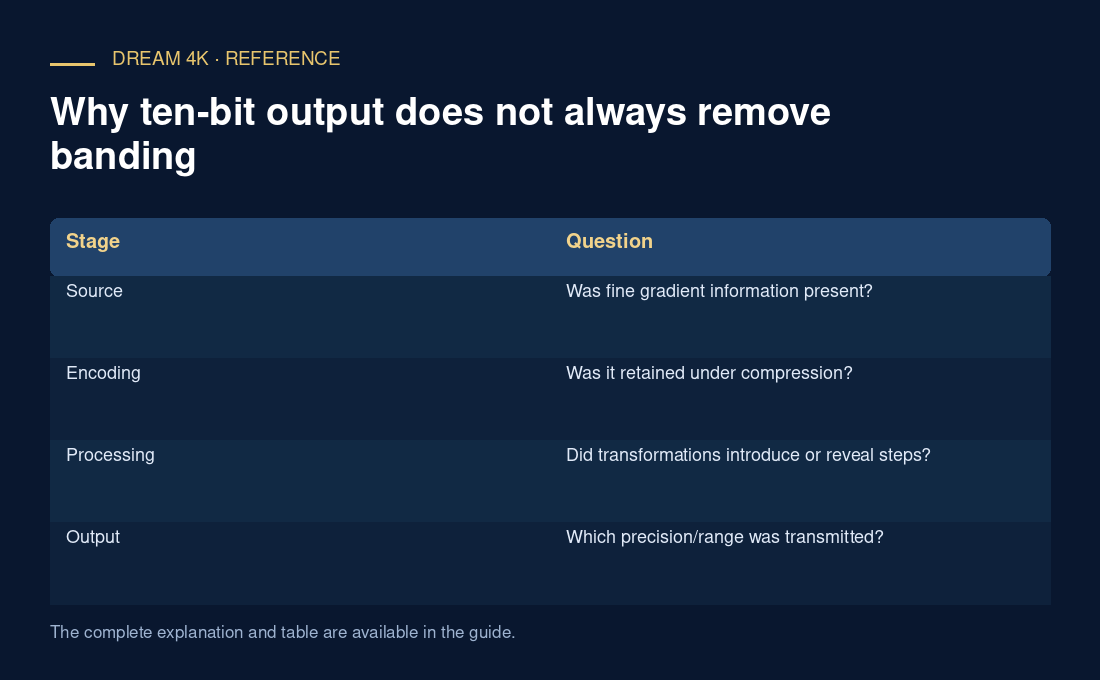
| Stage | Question |
|---|---|
| Source | Was fine gradient information present? |
| Encoding | Was it retained under compression? |
| Processing | Did transformations introduce or reveal steps? |
| Output | Which precision/range was transmitted? |
| Display | How did the known signal appear? |