
In this guide
Establish a known signalCheck the declared and received layoutsMake one supported comparisonHearing music from several speakers does not prove that every intended channel is mapped correctly. Receiver processing can distribute sound, and an unfamiliar programme may not exercise each position in an obvious way.
A known permitted channel-identification source is a better diagnostic. Record its declared layout and the actual output route before attributing missing dialogue or another symptom to the streaming source.
Establish a known signal
Use a source that explicitly identifies its intended channels and is appropriate for the supported system. Keep volume at a comfortable level and avoid unknown “maximum volume” test files. Record which spoken or labelled channel is heard at which endpoint.
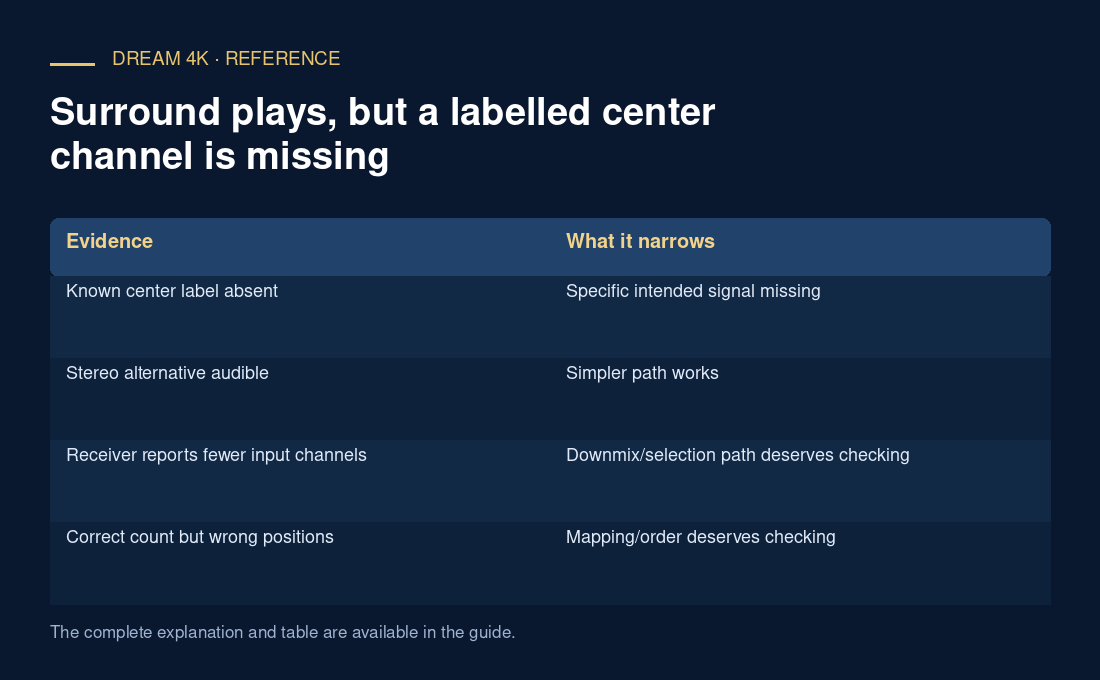
In an original hypothetical six-channel test, left and right labels are heard correctly but the center label is absent. That is more specific than a film sounding quiet. It supports investigating the center signal’s selection, mapping and endpoint path, while leaving the exact component responsible unresolved.
Check the declared and received layouts
Record source codec/layout, player output format and receiver input-channel information. Compare those with the configured physical speakers. A downmix to stereo, an ordering mismatch and an inactive center endpoint are different possibilities. Do not assume a channel count alone proves correct positional mapping.
If an application or conversion changes containers/codecs, preserve that context. Some format mappings use different channel orders and require deliberate remapping. A generic six-channel label does not specify every ordering convention.
Make one supported comparison
A documented stereo alternative can show whether the programme remains audible through a simpler path, but it does not by itself prove which multichannel stage failed. A known labelled test through the same output chain is a stronger mapping comparison. Record every change and restore the intended supported settings afterward.
A useful report states the known test identity, source layout, output/receiver format and the exact missing or misplaced label. If only an ordinary programme was observed, say that the mix is unconfirmed. Avoid promising that enabling passthrough, forcing a surround mode or increasing a dialogue enhancer will repair every missing-channel case.
| Evidence | What it narrows |
|---|---|
| Known center label absent | Specific intended signal missing |
| Stereo alternative audible | Simpler path works |
| Receiver reports fewer input channels | Downmix/selection path deserves checking |
| Correct count but wrong positions | Mapping/order deserves checking |