
In this guide
Build a short startup timelineObserve a later stall independentlyCompare only like stagesWaiting ten seconds before the first frame and freezing ten minutes into a programme are different observations. They can share a cause, but they do not measure the same stage of playback. Startup includes work that a continuing session may already have completed.
A useful investigation marks the sequence from pressing play to receiving and presenting media, then compares it with the request and buffer behavior during a later stall.
Build a short startup timeline
Record when play was requested, when the entry playlist or file response began, when initialization and first media arrived, and when the first frame appeared. Use the player’s own diagnostics where available. Keep the measurements on one clock rather than combining unsynchronized timestamps from unrelated devices.
In an original hypothetical session, the entry request waits three seconds for a response, then the first segments transfer in one second, and the player waits another two seconds before presenting. That six-second startup is not explained by simply saying the first segment took six seconds to download. The stages identify different questions.
Observe a later stall independently
During established playback, note whether segment requests become late and whether playable buffer depth decreases. A new authentication request, playlist refresh or decoder transition can also occur midstream, so classify the actual failing dependency. Do not assume connection setup is repeated for every segment; connection reuse and protocol behavior vary.
If the buffer stays substantial while the picture stops and audio continues, preserve render and decoder evidence. If the buffer reaches zero after several late requests, preserve the delivery sequence. Both deserve more precision than a general “high latency” label.
Compare only like stages
Repeat a start once under the same conditions, noting whether caches or an existing connection may change the result. Compare a different permitted item only as a controlled contrast, not as proof of a whole catalogue’s behavior. Avoid repeatedly pressing play during a pending request, which may create overlapping sessions or obscure the original timing.
A useful support report states startup stage timings separately from the later stall interval. This lets a developer investigate name resolution, server response, buffering policy, media parsing or decoder initialization as appropriate. A low ping alone cannot eliminate those stages, and a slow first frame does not establish a sustained bandwidth shortfall.
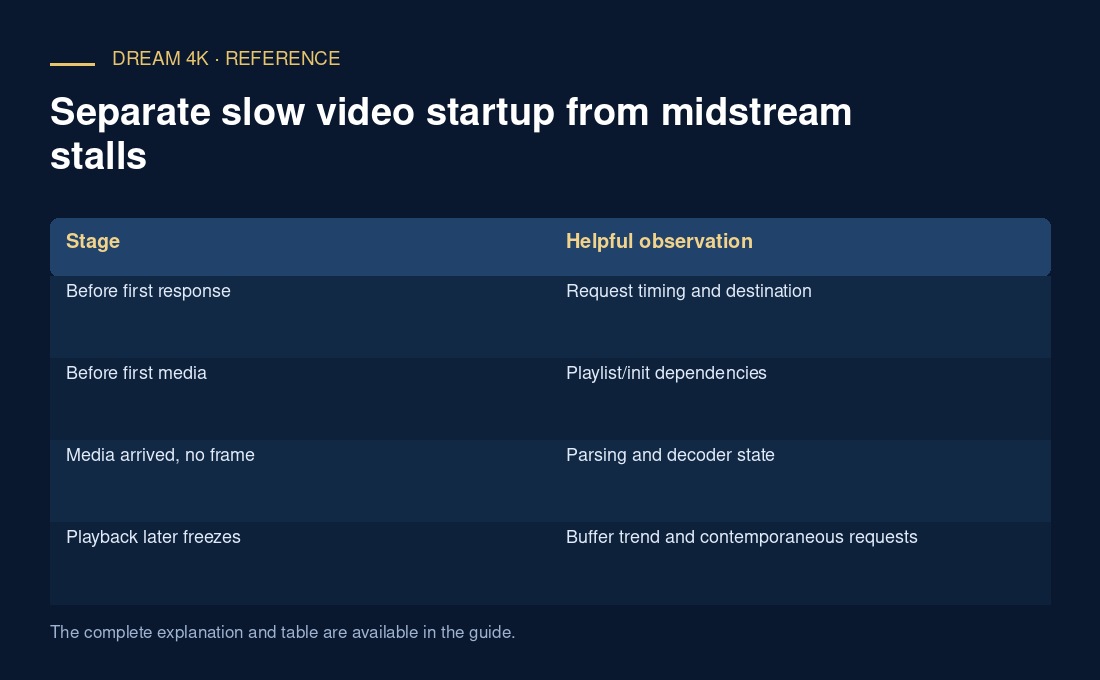
| Stage | Helpful observation |
|---|---|
| Before first response | Request timing and destination |
| Before first media | Playlist/init dependencies |
| Media arrived, no frame | Parsing and decoder state |
| Playback later freezes | Buffer trend and contemporaneous requests |