
In this guide
Model the workload before interpreting the settingObserve what each mode actually selectsChoose from observed supported behaviorA fixed highest-quality preference can hold a more demanding workload while an automatic mode may choose a lower offered rendition. The visible control does not reveal the actual selection or prove which strategy will be stable on a particular path.
Make a supported reversible comparison in one player, preserving the item and nearby network conditions. Record the selected track and playback consequences rather than ranking modes from their names.
Model the workload before interpreting the setting
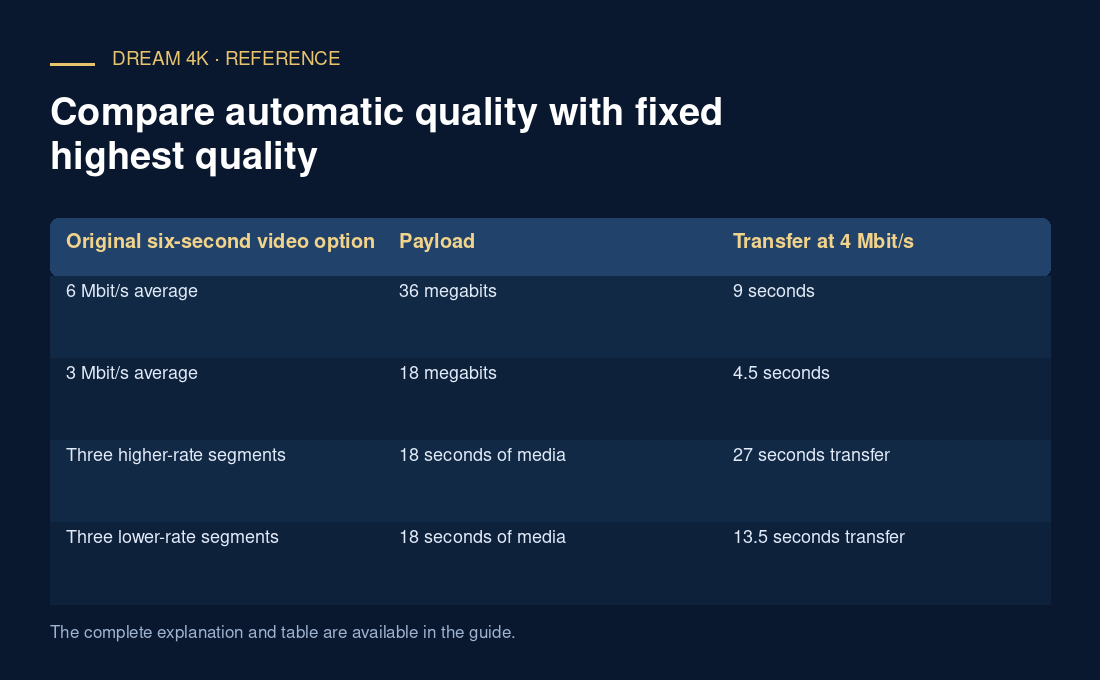
In an original hypothetical model, a six-second segment at an average 6 Mbit/s contains 36 megabits. At a constant 4 Mbit/s payload delivery rate, retrieval takes nine seconds. Three such segments provide eighteen seconds of media while using twenty-seven seconds of sequential transfer, a nine-second deficit.
A compatible 3 Mbit/s alternative contains eighteen megabits per six-second segment. At the same hypothetical delivery rate, each takes 4.5 seconds, so three provide eighteen seconds of media in 13.5 seconds. This simplified surplus/deficit model ignores overhead, parallel tracks and request scheduling; it is not a universal connection requirement.
Observe what each mode actually selects
Record codec, dimensions, frame rate and declared rate under the fixed and automatic preferences. If the automatic mode changes several attributes, preserve them. A lower workload working does not isolate bit rate when codec or frame rate also changed.
Check request outcomes and buffer trend over several segments. A failed resource is different from a late successful transfer. If the player ignores or constrains a preference, use its documented behavior rather than assuming the control created a guaranteed fixed selection.
Choose from observed supported behavior
Restore temporary test settings after recording the comparison, or retain the documented mode that meets the intended viewing need. Automatic selection can favor continuity under changing conditions, but its algorithm and available alternatives vary by player/source. It is not a promise of the highest picture detail or permanent stability.
A useful report states the actual configurations, before/after buffer trend, request timing and any changed conditions. It can identify a selection-sensitive problem without claiming an ISP minimum, account downgrade or source-quality guarantee. The evidence should explain what workload was sustainable during the observed interval.
| Original six-second video option | Payload | Transfer at 4 Mbit/s |
|---|---|---|
| 6 Mbit/s average | 36 megabits | 9 seconds |
| 3 Mbit/s average | 18 megabits | 4.5 seconds |
| Three higher-rate segments | 18 seconds of media | 27 seconds transfer |
| Three lower-rate segments | 18 seconds of media | 13.5 seconds transfer |