
In this guide
Choose the events that affect the questionPreserve dates and status labelsAdd the source referenceEnd with one precise requestA timeline can make a purchase issue easier to explain than a long transcript. Record the material events with their sources and distinguish them from your interpretation. Keep the timeline focused on the order rather than copying every conversation or account secret.
Choose the events that affect the question
Useful events can include the quote, customer approval, payment initiation, seller acknowledgment, account action confirmation and the customer’s later observation. These are not necessarily simultaneous. A message marked sent records delivery through that tool, not the completion of an account change.
Preserve dates and status labels
Use full dates and a time zone when available. Keep the payment provider’s actual status wording rather than translating pending into paid. If a source gives only a date, do not invent a time. Mark approximate recollections as approximate so they do not look like system timestamps.
Add the source reference
Connect each event to its relevant receipt, conversation or account observation in the protected record. Use a non-secret reference in the summary.
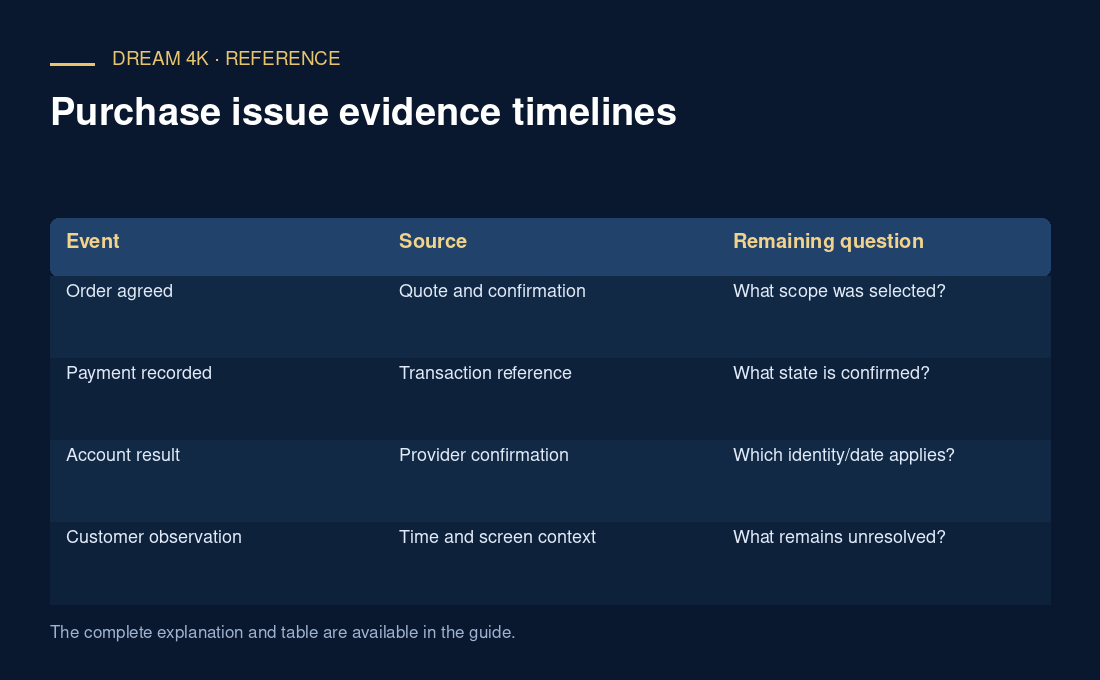
| Event | Source | Remaining question |
|---|---|---|
| Order agreed | Quote and confirmation | What scope was selected? |
| Payment recorded | Transaction reference | What state is confirmed? |
| Account result | Provider confirmation | Which identity/date applies? |
| Customer observation | Time and screen context | What remains unresolved? |
End with one precise request
Ask the responsible party to explain the gap between particular events, such as payment confirmation and an unconfirmed account result. Keep unrelated software charges as a separate issue if needed. Preserve the answer and update the current account record. This procedure organises evidence; it does not determine fault or promise a dispute outcome.
Questions about this guide
Should I include a suspected cause in the timeline?
Keep the observed event in the timeline and label the suspected cause separately. For example, a screen displayed an earlier date is an observation; an old profile may be selected is a hypothesis. This keeps the record useful if the first explanation turns out to be wrong.