
In this guide
Read timing and location togetherA changing file needs comparison over timeDo not infer the wrong guaranteeAn HLS media playlist is an ordered description of media resources for one rendition. It tells a player which segments belong to the presentation and how long they last. Unlike a multivariant playlist, it does not primarily offer a menu of video qualities.
The file is a snapshot of the published timeline. A live playlist can change as new segments appear and older ones leave the window. A saved copy therefore describes what was advertised when it was retrieved, not necessarily what is available later.
Read timing and location together
EXTINF supplies a duration for the next segment, followed by a URI identifying that segment’s resource. A relative URI is resolved against the playlist URL. Other tags provide shared constraints or context, including target duration, media sequence, discontinuities and initialization data.
An original illustrative playlist might list three four-second segments. Its listed media duration is twelve seconds, but this is not automatically the viewer’s end-to-end delay. Capture delay, publication timing, selected playback position and client buffering all sit outside that simple sum.
A changing file needs comparison over time
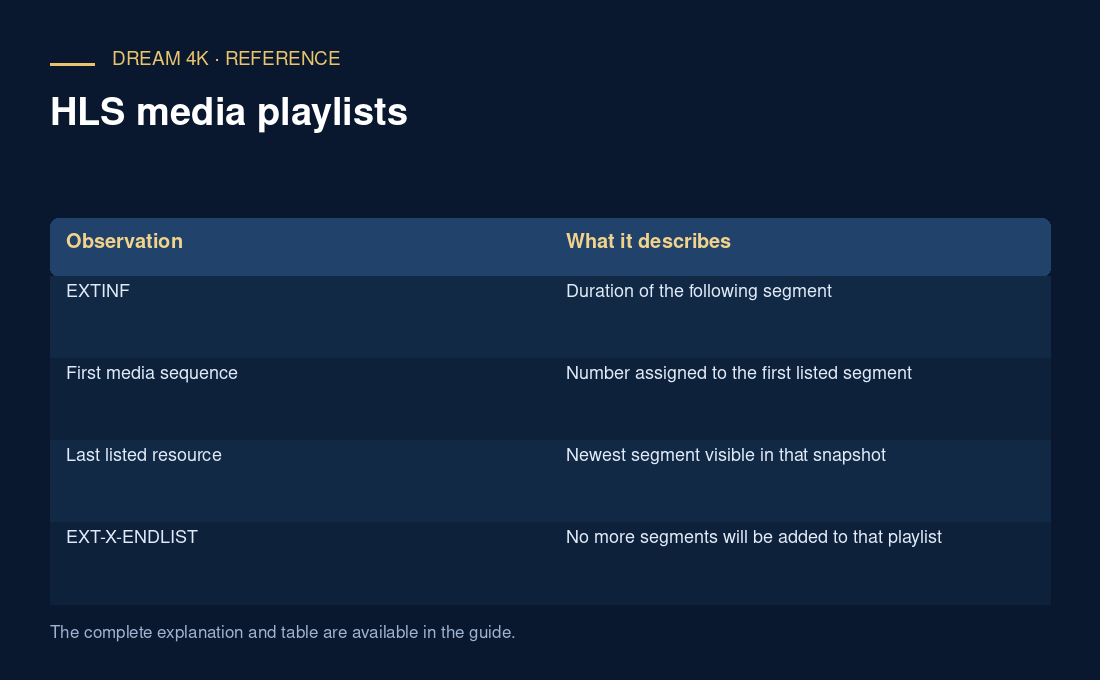
For a live session, compare successive responses rather than assuming an unchanging address returns unchanging text. Record retrieval time, first sequence number, last listed resource and whether the response was served from a cache. A new segment location can appear while the playlist URL remains identical.
| Observation | What it describes |
|---|---|
| EXTINF | Duration of the following segment |
| First media sequence | Number assigned to the first listed segment |
| Last listed resource | Newest segment visible in that snapshot |
| EXT-X-ENDLIST | No more segments will be added to that playlist |
Do not infer the wrong guarantee
A well-formed playlist does not prove its segments can be fetched, decoded or legally viewed. A missing resource might be outside the current live window, temporarily unavailable or incorrectly referenced. The failed request and the playlist snapshot are needed to distinguish those cases.
When sharing evidence, retain the segment’s role and relative position while redacting credentials. Changing or renumbering a provider playlist locally can destroy the timeline evidence and is not a general repair for a source-side publishing problem.