
In this guide
Define the viewing requirement firstAssess delivery using reproducible observationsRead account and pricing terms separately from picture qualityEvaluate guide, audio and support as part of the serviceCompare like evidence and state its limits“Best IPTV server” is not a meaningful technical conclusion without a defined task and evidence. A service that works for one device, region, programme or time window may not meet another viewer’s needs. A server label alone does not describe the full capture, packaging, CDN, network, player and display path.
Use a clear set of criteria and record what is known, observed and still unconfirmed. This guide provides an assessment framework; it does not present an invented winner, personal benchmark or universal reliability ranking.
Define the viewing requirement first
List the exact device/player, intended connection, required languages, accessibility options and programme types. Distinguish live viewing from replay or recording needs. A pause control, programme listing or familiar logo does not establish catch-up access, rights or current source inclusion.
Check exact-model and player support for the selected media configuration. Container, codec, dimensions, frame rate, audio format and output path can all matter. A generic promise of “4K compatible” leaves too many of those requirements unspecified.
Assess delivery using reproducible observations
For an authorized evaluation, record the item, date/time zone, device/player version and network conditions. Note startup behavior, segment request outcomes and whether playback remains continuous across representative transitions. A short successful session is evidence for that session, not a statistical uptime guarantee.
Where diagnostics exist, distinguish late delivery from decode/render issues. Segment duration versus transfer time and buffer trends are more directly relevant than a speed-test result to another destination. Avoid testing several simultaneous sessions unless the account explicitly permits that use.
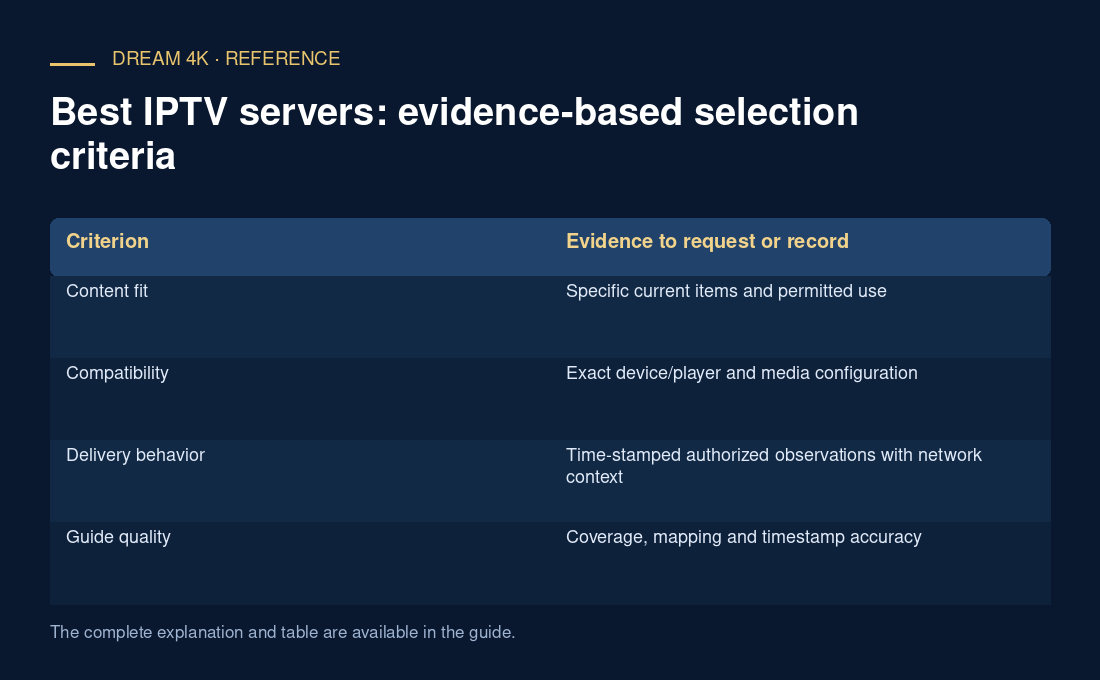
| Criterion | Evidence to request or record |
|---|---|
| Content fit | Specific current items and permitted use |
| Compatibility | Exact device/player and media configuration |
| Delivery behavior | Time-stamped authorized observations with network context |
| Guide quality | Coverage, mapping and timestamp accuracy |
| Audio/captions | Actual offered tracks and their behavior |
| Account terms | Duration, total cost and connection allowance |
| Support | Published contact route and a clear issue process |
Read account and pricing terms separately from picture quality
Confirm the full selected-term cost, duration, renewal meaning, connection allowance and any separate player fees. Do not infer simultaneous-use rules from a channel count or a reseller credit figure. If a term is not published or confirmed, keep it marked as unresolved.
A service subscription and a player licence can be separate products. A working player demonstration does not establish an account entitlement, and a subscription payment does not guarantee that every third-party app is included. These distinctions prevent a technical comparison from hiding practical costs or access limits.
Evaluate guide, audio and support as part of the service
A populated EPG should match the intended feed and time zone, not merely show many rows. Test representative language and caption options that matter to you, while recognizing availability can vary by item. A logo or poster does not establish membership in an app, event rights or a title’s present availability.
For support, look for a public contact route and prepare a concise redacted report: affected item/time, player/device, exact error and first failed stage. Do not judge responsiveness from fabricated reviews or invented personal contact. If you have not contacted support, say the route is published rather than claiming its response quality was tested.
Compare like evidence and state its limits
An original hypothetical comparison has service A observed on Ethernet at midday and service B observed on Wi-Fi during a busy evening. Those results do not isolate service performance. A fairer comparison keeps the client, local path, workload and observation windows as similar as practical and still reports the remaining differences.
Choose on the basis of verified requirements and representative evidence, with unresolved terms made explicit. Avoid claims of permanent access, guaranteed zero buffering, unlimited device use or a fixed global server ranking. The best-supported decision is the one whose evidence matches the viewer’s actual task and whose limits are visible.