
In this guide
Ask what format helps the taskRecord the preference neutrallyUse it in the next responseReview purpose and retentionA customer may prefer written steps, a concise summary after a call or one question at a time. A useful case note records that practical preference for a defined support purpose. It should not turn an accessibility request into a broad collection of sensitive personal information.
Ask what format helps the task
Offer an appropriate concrete choice when possible, such as text directions instead of an image-only explanation. Do not assume a person’s preference from their age, device or a disability label. The customer can describe the interaction barrier without explaining a medical history.
Record the preference neutrally
Write “prefers ordered text steps” rather than an agent’s judgment about capability. State whether the preference applies to the current case or future support where the actual process allows that. Keep the note available only to people who need it for the support task.
Use it in the next response
A recorded preference is useful only if the next agent follows it. Break instructions into clear steps, preserve relevant field labels and provide a short result summary. If the requested format is not available, explain the actual supported alternative instead of promising a capability the team does not have.
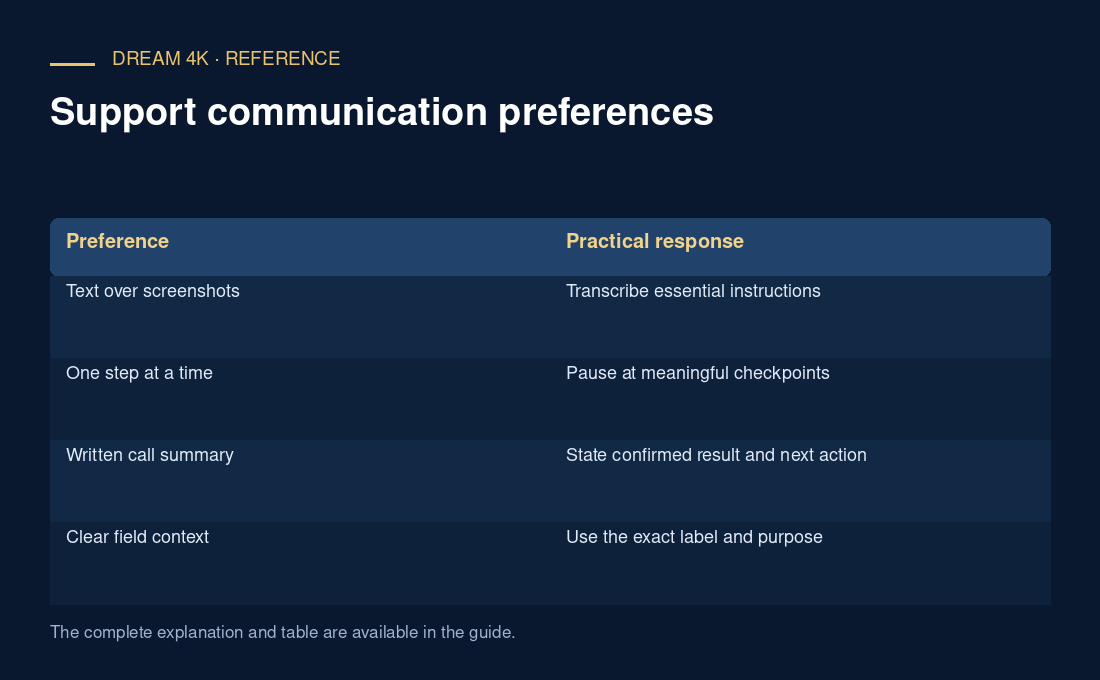
| Preference | Practical response |
|---|---|
| Text over screenshots | Transcribe essential instructions |
| One step at a time | Pause at meaningful checkpoints |
| Written call summary | State confirmed result and next action |
| Clear field context | Use the exact label and purpose |
Review purpose and retention
Keep the note accurate and remove unnecessary detail under the organisation’s actual record process. ICO’s minimum-data principle is a useful reference for collecting only what serves the purpose; this is not a compliance assessment. This guide does not promise a particular Dream support channel, staffing model or accessibility service.
Questions about this guide
Can a customer change a recorded preference?
Treat the preference as current task context, not a permanent assumption about the person. Update the relevant note when the customer gives a new instruction, following the organisation’s actual process. Do not keep using an old format simply because it appears in a previous case.