
In this guide
Name the disagreement preciselyFind the relationship between recordsAn illustrative reconciliation tableUpdate after confirmationWhy this improves the next requestAn app says one date; a confirmation says another. A local profile has one name; the receipt uses an unfamiliar reference. It is tempting to “clean up” the record by keeping whichever value looks newest. That can remove the very evidence needed to explain the mismatch.
Reconciliation means identifying why records differ and which source answers the question. It should not mean choosing a convenient value before the account relationship has been confirmed.
Name the disagreement precisely
Write the values side by side with their sources and observation times. Avoid a broad statement such as “all the details are wrong.” For example, state that the service confirmation identifies Order A while the selected profile is associated with an earlier record. The problem may be a mistaken profile selection rather than a failed renewal, but that remains a hypothesis until checked.
Find the relationship between records
Ask which account each record describes. An order reference, a local label and a player-licence receipt do not share a universal identifier. Build the relationship through the original private purchase trail and the responsible seller’s confirmation. Do not attempt to resolve uncertainty by comparing passwords in a public conversation. Sensitive values are poor labels and unnecessary evidence for most opening requests.
An illustrative reconciliation table
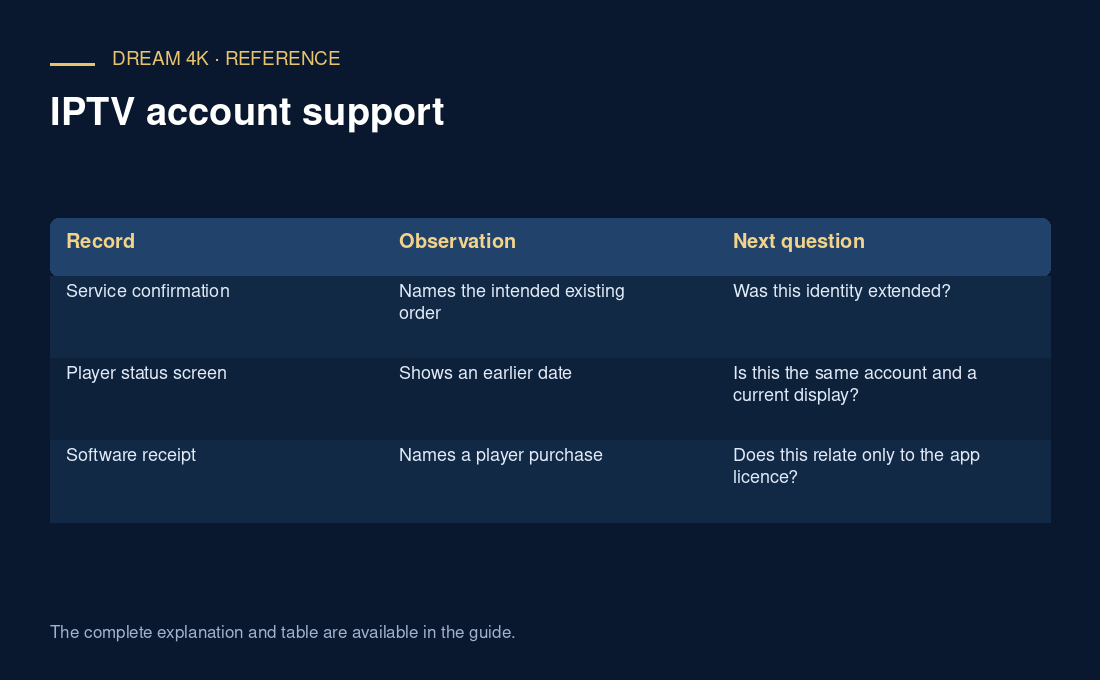
The table below describes a made-up case. Its purpose is to keep an observation, a hypothesis and a needed answer separate.
| Record | Observation | Next question |
|---|---|---|
| Service confirmation | Names the intended existing order | Was this identity extended? |
| Player status screen | Shows an earlier date | Is this the same account and a current display? |
| Software receipt | Names a player purchase | Does this relate only to the app licence? |
Update after confirmation
Once the seller explains the difference, add the explanation and date to the private record. Preserve the earlier evidence for as long as it remains useful to the purchase or unresolved case. Mark the current value clearly so a later household handover does not reopen the same question. If only part of the disagreement has been explained, leave the remaining item pending.
Why this improves the next request
A concise reconciliation note gives support a focused task: confirm the account relationship or the resulting date. A cleaned-up record containing only your preferred value does not reveal where the mismatch started. Keeping both observations also avoids an unnecessary second order or disruptive reinstall while the original account is still being identified. The useful final record contains a supported explanation, not merely a neater spreadsheet.
Questions about this guide
What if the older record turns out to be wrong?
Mark it as superseded and record the confirming explanation, rather than continuing to use it as current information. Retain it only while it remains useful to understand the case or purchase. The final current record should be easy to identify. Keeping history does not mean giving obsolete values equal status; it means preserving enough context to explain how the reliable answer was established.