
In this guide
Record video and audio as separate selectionsCheck whether the presentation context changedMake a precise report or controlled correctionA DASH player can lower its video workload while retaining the same language, because video adaptation and audio selection are different decisions. If the spoken language changes unexpectedly, record the actual audio group or representation rather than assuming the video downshift required it.
The manifest structure, player preferences and available compatible combinations all matter. Do not infer a universal selection algorithm from one application’s menu.
Record video and audio as separate selections
Note the active Period, selected video representation and selected audio language/role. Repeat that record immediately after the unexpected change. Where diagnostics are limited, at least preserve displayed options and the observation time.
In an original hypothetical presentation, the video changes from v-high to v-low while English audio a-en continues. That is a video adaptation. If audio changes to a-es at the same moment, it is an additional selection change that needs its own explanation, such as manifest context, client preference or a boundary transition.
Check whether the presentation context changed
A new Period can introduce different groups or defaults. A track disappearing from a live update can also affect available choices. Preserve the before/after MPD context rather than assuming the same menu remained valid throughout.
Compare audio labels with actual spoken content. Incorrect metadata and incorrect selection are different problems. A selected English label carrying Spanish content should be reported as a label/content mismatch, not silently treated as evidence that the user chose Spanish.
Make a precise report or controlled correction
If the player offers a documented audio selection, choose the intended option and note whether it persists across a video quality change or Period transition. Keep video quality preferences otherwise unchanged for that comparison. Do not rewrite the manifest or force unrelated codec settings.
A useful report includes before/after video and audio identifiers, language/role labels, active Period and playback position. If only the visible menu is available, state that limit. This preserves a distinct audio-selection question without claiming that every DASH implementation exposes the same controls or that a quality change must alter language.
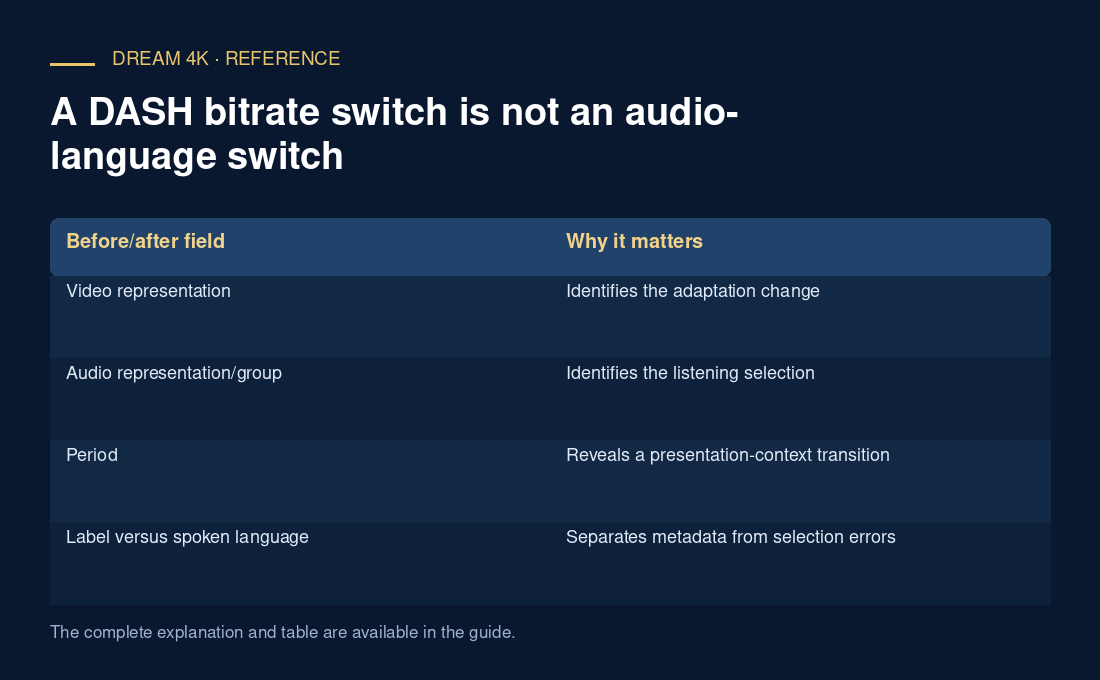
| Before/after field | Why it matters |
|---|---|
| Video representation | Identifies the adaptation change |
| Audio representation/group | Identifies the listening selection |
| Period | Reveals a presentation-context transition |
| Label versus spoken language | Separates metadata from selection errors |